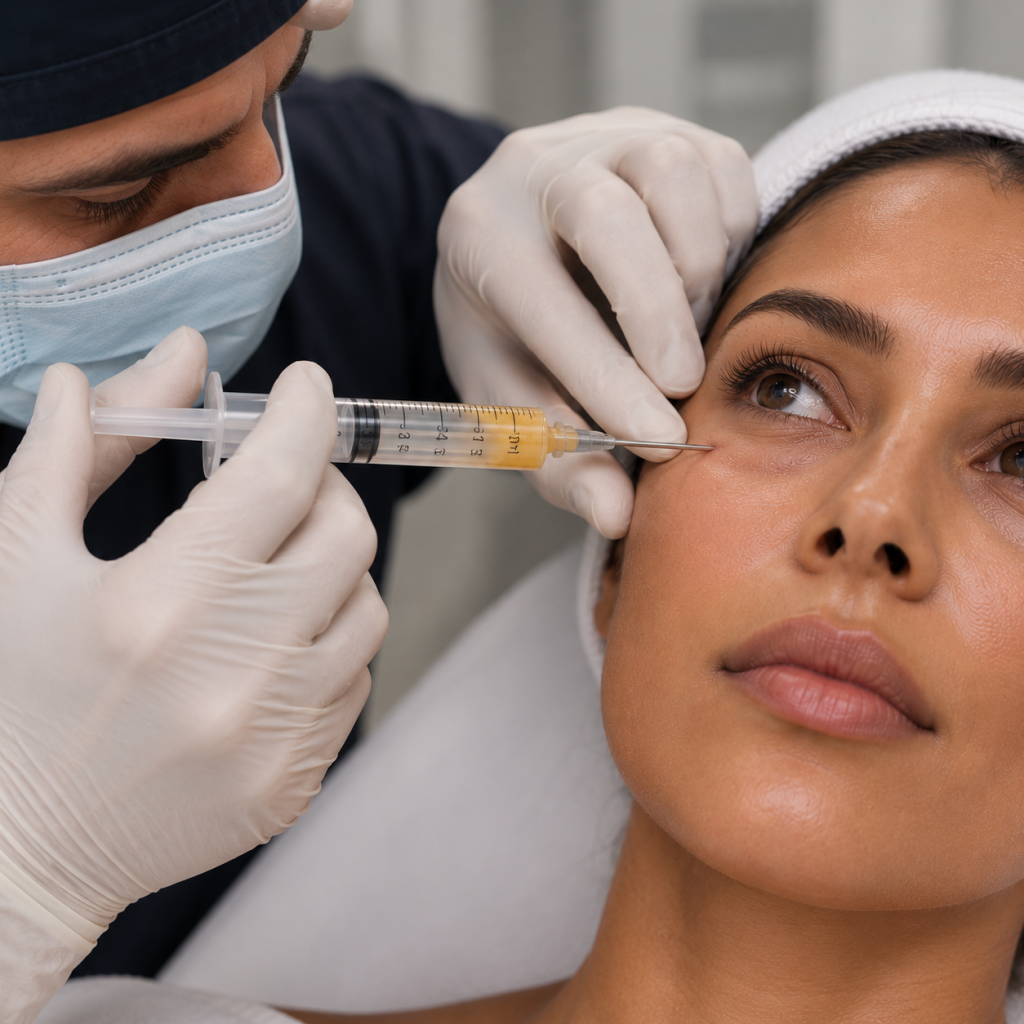
Searching for the best clinic for under-eye fat transfer can be difficult. Before-and-after photographs may look impressive, clinics use different techniques, and the procedure itself is sometimes presented as though it were simply a more permanent alternative to under-eye filler.
In reality, under-eye fat transfer is a highly technique-dependent surgical procedure. The under-eye area has thin skin and complex anatomy, meaning that patient selection, the way the fat is prepared, and precisely where and how much is placed can significantly influence the final result.
For this reason, choosing a clinic should begin with the surgeon rather than with a promise of being “the best”.
At our clinic, under-eye fat transfer is performed by Dr Abdul Nassimizadeh and Dr Ayad Harb, Plastic Surgeons, with treatment planned around the individual anatomy of the eyes, cheeks and surrounding face.
Under-eye fat transfer, sometimes called under-eye fat grafting, uses a patient’s own fat to restore volume around the lower eyelid and tear trough area.
A small amount of fat is first harvested from another area of the body, commonly through gentle liposuction. It is then carefully processed before being introduced into selected areas beneath and around the eyes.
Unlike hyaluronic acid dermal fillers, which introduce a manufactured gel to create volume, fat transfer uses the patient’s own tissue.
The aim is not to make the under-eye area look fuller. It is to restore volume where it has been lost and create a smoother transition between the lower eyelid and cheek.
The tired appearance people associate with their eyes is not always caused by lack of sleep.
Ageing affects several structures around the eyes. Facial fat compartments change, the skin becomes thinner, collagen decreases and the underlying bone gradually remodels. Genetics can also mean that some people naturally have deeper tear troughs or hollows from a relatively young age.
These changes can create shadows beneath the eyes, making someone appear tired even when they feel perfectly rested.
Dr Abdul Nassimizadeh explains:
“The under-eye shouldn’t be assessed in isolation. We need to look at the relationship between the lower eyelid, tear trough and cheek because what appears to be an under-eye problem may actually be partly caused by loss of support elsewhere.”
If you are searching for the best clinic for under-eye fat transfer, one of the most important factors is whether the procedure is being approached as surgery rather than simply another injectable treatment.
The consultation should include an assessment of the lower eyelid, tear trough, cheek volume, skin quality and facial proportions.
Your surgeon should also explain what fat transfer can and cannot correct.
For example, under-eye darkness caused predominantly by pigmentation will not necessarily disappear by adding volume. Similarly, significant excess lower-eyelid skin or prominent eye bags may require a different surgical approach.
A reputable clinic should be willing to tell you when fat transfer is not the right treatment.
Fat transfer involves much more than moving fat from one part of the body to another.
The transferred fat must survive in its new location by establishing a blood supply. Some of the transferred cells survive long term, while a proportion is naturally reabsorbed during healing.
The surgeon therefore needs to balance several considerations: how much fat to place, where it should be positioned and how the tissues are likely to heal.
This becomes particularly important beneath the eyes because the skin is thin and excessive or uneven placement may be visible.
Dr Nassimizadeh says:
“With under-eye fat transfer, more isn’t better. The objective is a smooth, natural transition between the eyelid and cheek. Conservative, precise placement is particularly important in this area.”
Both treatments can address under-eye hollowing, but they are not interchangeable.
Tear trough filler generally uses hyaluronic acid to restore volume and can be performed without surgery. Results are temporary and filler can be dissolved when a hyaluronic acid product has been used.
Fat transfer involves harvesting and grafting your own fat and is therefore a surgical procedure. Fat that successfully establishes itself in the treated area can remain long-term, although the face will continue to change naturally with ageing.
There are advantages and limitations to both approaches.
Some patients may be more appropriate candidates for filler, others for fat transfer, while some should not have additional volume placed beneath the eyes at all.
Under-eye hollows are one of the main reasons someone may consider facial fat transfer.
Carefully restoring volume can soften the depression between the lower eyelid and upper cheek. This may also reduce some of the shadowing created by the hollow.
However, the distinction between shadow and pigmentation is important. Fat transfer may improve darkness caused by the way light falls across a hollow, but it cannot be expected to remove brown or blue pigmentation within the skin itself.
This is why diagnosis matters before treatment.
It can produce very natural-looking results when appropriately planned.
The objective is not to erase every contour beneath the eyes. Natural faces contain transitions, shadows and asymmetry. Attempting to completely flatten the under-eye area can itself create an unnatural appearance.
Dr Nassimizadeh explains:
“Good facial surgery shouldn’t announce itself. With fat transfer, we’re trying to restore what has been lost while respecting the patient’s existing facial anatomy.”
This conservative philosophy is particularly relevant around the eyes, where even relatively small changes can have a noticeable effect on the overall face.
Fat transfer is considered a long-lasting treatment, but describing every transferred fat cell as permanent would be misleading.
During the first few months, some of the transferred fat will naturally be reabsorbed. The fat that successfully develops a blood supply can remain as living tissue in its new location.
That tissue can subsequently respond to ageing and changes in body weight just like fat elsewhere in the body.
Results therefore tend to be longer-lasting than temporary injectable fillers, but they do not stop the natural ageing process.
Swelling and bruising are expected following under-eye fat transfer. There may also be swelling or tenderness where the fat was harvested.
The initial appearance should not be considered the final result. Early swelling can make the under-eye area look fuller before it gradually settles.
Over the following weeks and months, swelling reduces and the surviving transferred fat integrates with the surrounding tissue. Your surgeon will advise when the result can reasonably be assessed.
As with any surgical procedure, fat transfer carries risks.
These can include swelling, bruising, infection, asymmetry, contour irregularities, under-correction or over-correction, and unpredictable fat survival. Fat necrosis or small lumps can also occur. Rare but serious vascular complications have been reported with facial fat injection.
A responsible consultation should discuss these risks rather than presenting fat transfer as a risk-free or completely predictable procedure.
Rather than relying solely on searches for the best clinic for under-eye fat transfer, ask who will actually perform your procedure and how frequently they work with facial fat grafting.
Look at before-and-after results involving patients with concerns similar to yours. Ask why the surgeon believes fat transfer is suitable for your anatomy, what alternatives exist, what recovery involves and what happens if the fat survives unevenly or less volume remains than expected.
You should leave the consultation understanding both the potential benefits and limitations of treatment.
There is no objective single “best clinic” for every patient. The right clinic is one where the procedure is performed by an appropriately qualified surgeon, your anatomy is carefully assessed, risks and alternatives are discussed openly, and the treatment plan prioritises a natural result rather than simply adding volume.
At SRGN, Dr Abdul & Dr Ayad approach under-eye fat transfer as part of the wider facial anatomy, considering the relationship between the lower eyelids, tear troughs and cheeks before recommending treatment.
For patients whose tired appearance is genuinely caused by volume loss, carefully planned fat transfer can restore softer contours using their own tissue while preserving the natural character of the face.
There is no single country that is objectively best for fat grafting. The surgeon’s qualifications, experience in facial fat transfer, safety standards and aftercare are more important than location. For under-eye fat transfer in particular, choosing an experienced surgeon who understands the delicate anatomy of the lower eyelid and face is essential. Having surgery in the UK can also make consultations, follow-up appointments and access to your surgical team more straightforward.
The cost of under-eye fat grafting in the UK varies depending on the surgeon, clinic, extent of treatment, anaesthesia and whether fat transfer is combined with another procedure. Because every patient requires a different amount of correction, an accurate cost is usually provided following consultation. When comparing clinics, it is important to consider what is included in the fee rather than choosing a surgeon based on price alone.
Neither is universally better. Fat grafting transfers fat from another area of the body to restore under-eye volume, making it useful when hollowing or wider facial volume loss is the main concern. Fat repositioning typically redistributes existing lower-eyelid fat during blepharoplasty and may be more appropriate when prominent eye bags coexist with a tear-trough hollow. The right procedure depends on your lower-eyelid anatomy and should be determined during a surgical assessment.
