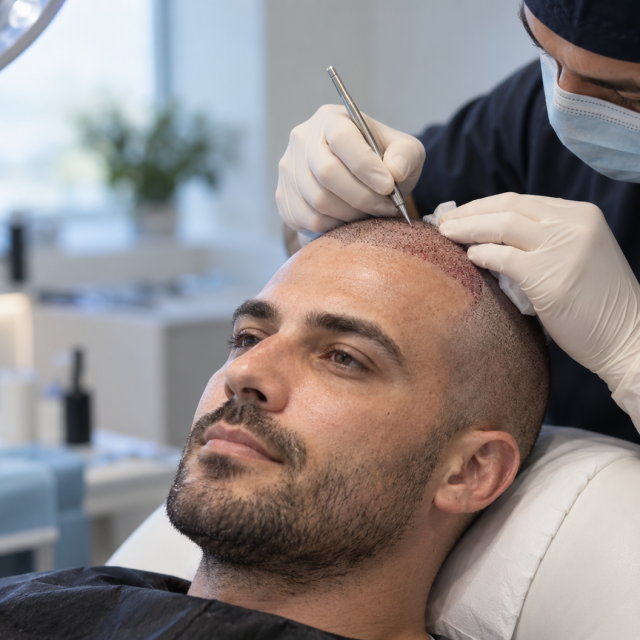
At SRGN, our hair transplant service is led by Dr Ahmed Riaz, a GMC-registered doctor with a dedicated focus on hair restoration. His approach combines careful medical assessment, precise FUE hair transplantation and long-term planning, with the aim of creating results that feel natural to you.
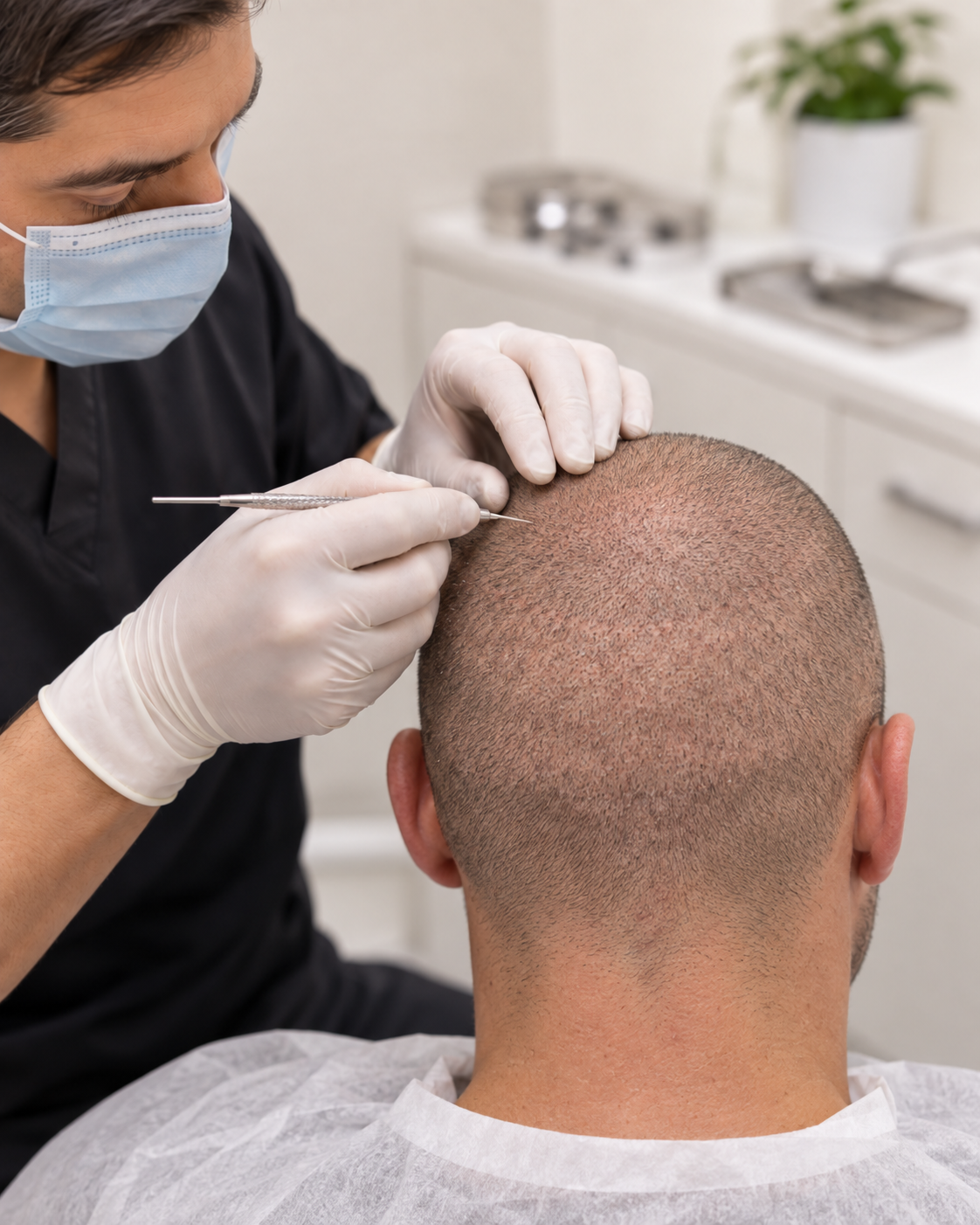
A hair transplant is a surgical procedure that moves healthy hair follicles from one part of the scalp to an area affected by permanent hair loss.
The follicles are usually taken from the back and sides of the scalp, known as the donor area, where hair tends to be more resistant to the processes responsible for common pattern hair loss.
These follicles are then carefully transplanted into areas where greater coverage or density is needed.
The principle sounds simple. Creating a convincing result is not.
A natural-looking hair transplant depends on thoughtful hairline design, careful management of the donor area and the precise positioning, direction and angle of each graft. It also requires consideration of what may happen to your existing hair in the years ahead.
For us, that long-term thinking is an important part of getting the treatment right.
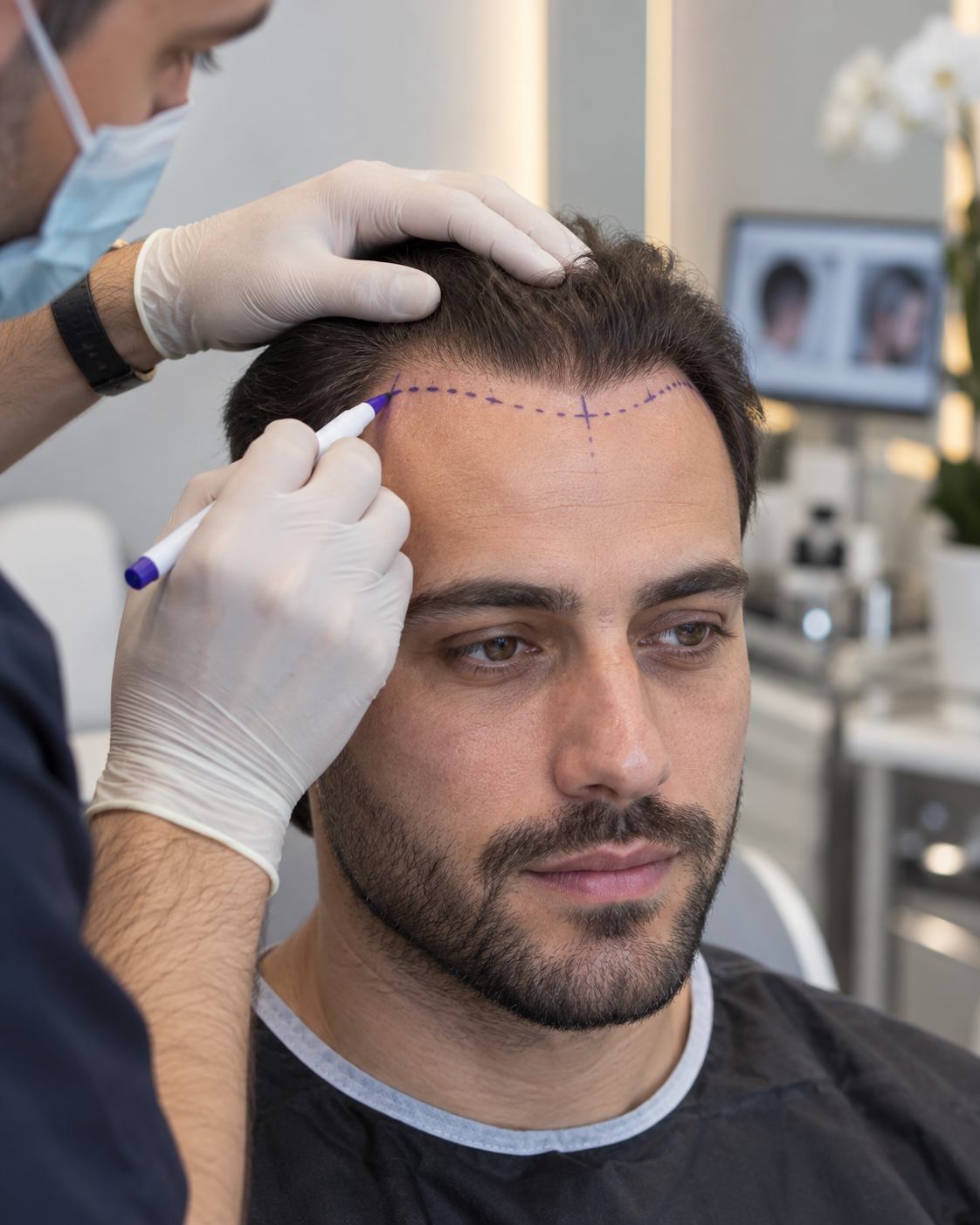
The hairline is often the first thing people think about when considering a hair transplant, but lower does not necessarily mean better.
A well-designed hairline needs to look appropriate for your face today while still making sense as you age.
Dr Riaz considers your facial proportions, existing hairline, pattern of hair loss, donor supply and the possibility of further hair loss before recommending a design.
Small irregularities and carefully planned changes in density can also be important. Natural hairlines are not perfectly straight or uniform.
The objective is balance rather than perfection.
At SRGN, Dr Ahmed Riaz specialises in Follicular Unit Extraction, commonly known as FUE.
FUE is a hair transplant technique in which individual follicular units are carefully extracted from the donor area rather than removing a strip of scalp.
Once the grafts have been harvested, recipient sites are created within the areas being restored. The follicles are then placed according to the agreed treatment plan.
Every part of this process matters.
The distribution of the grafts affects density. Their direction and angle influence how the hair sits. The shape and position of the hairline determine whether the result complements your face.
A good hair transplant should not draw attention to the fact that you have had one.
It should simply look like your hair.
Hair transplantation can be suitable for people experiencing certain types of permanent hair loss who have a healthy and sufficient donor area.
This may include people affected by male pattern hair loss, a receding hairline, temple recession, thinning through the frontal scalp or crown, and selected cases of female hair loss.
However, hair loss can happen for many different reasons.
Some conditions are temporary. Others may continue to progress. Certain forms of hair loss may require investigation or medical treatment rather than transplantation.
This is why suitability should never be determined from photographs alone.
During your consultation, Dr Riaz will assess your pattern of hair loss, scalp, donor density, medical history and expectations before advising whether a hair transplant is appropriate.
And sometimes, the right advice will be not to have one.
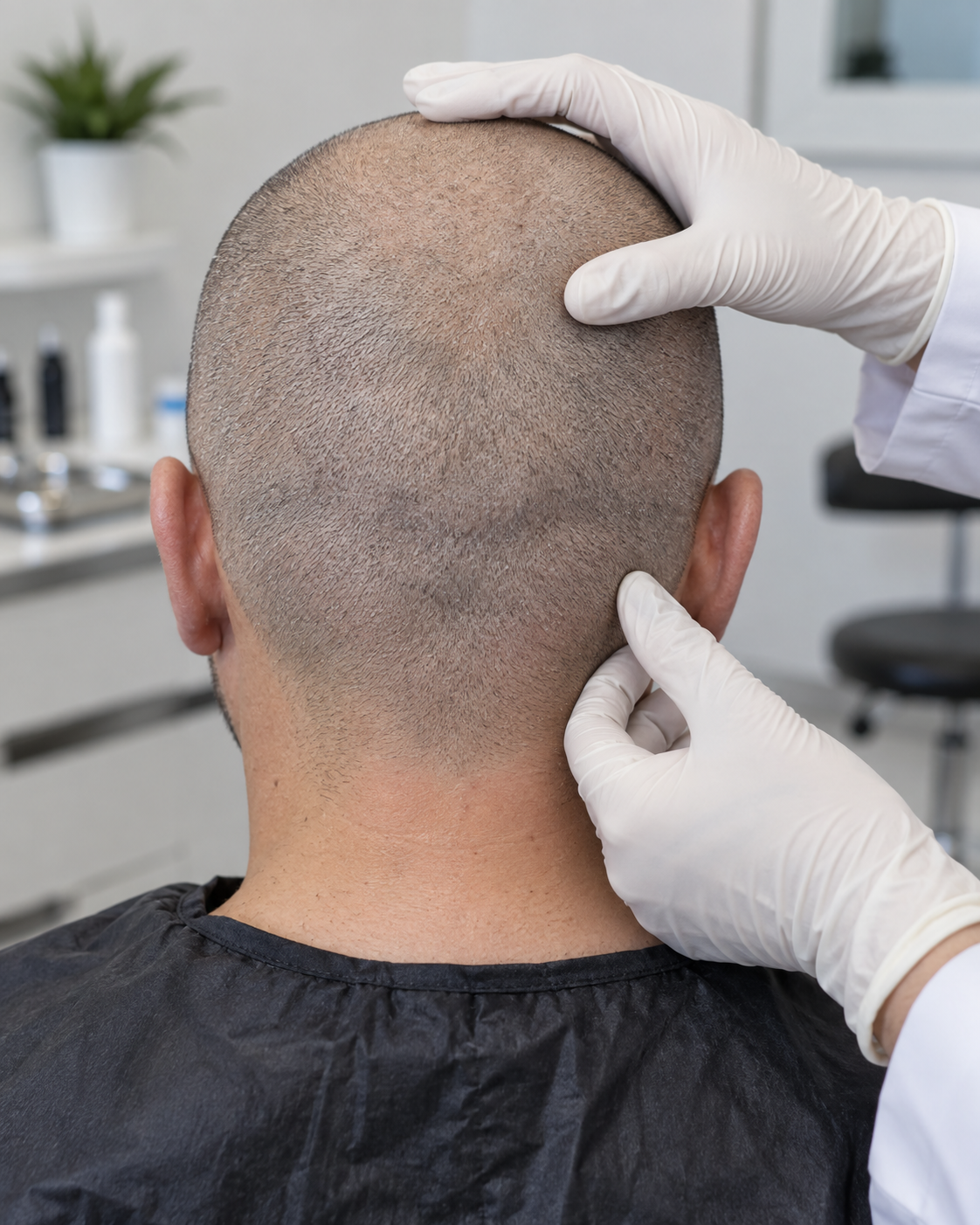
The donor area is one of the most important considerations in any hair transplant.
Although hair can be moved, the supply of suitable donor follicles is limited. Once a follicular unit has been extracted, it does not simply regenerate in the same place.
Good donor management therefore matters just as much as the area being restored.
Dr Riaz considers donor density, hair characteristics, existing hair loss and the possibility that further transplantation may be wanted or needed in the future.
The objective is not to use as many grafts as possible.
It is to use the available grafts intelligently.
Recovery after an FUE hair transplant happens in stages.
During the first few days, the scalp can feel tender and you may notice some redness, swelling and small scabs around the transplanted follicles. These are expected parts of the early healing process.
The grafts need particular care during this time.
You will be given detailed aftercare instructions explaining how to wash and protect the scalp, how to sleep during the initial recovery period and when you can return to exercise and other normal activities.
Many patients prefer to allow around one to two weeks before returning fully to work and social activities, although individual recovery varies.
PlanningBefore the procedure begins, Dr Riaz reviews your treatment plan and hairline design with you.The donor and recipient areas are carefully mapped according to the agreed approach.Harvesting the graftsIndividual follicular units are extracted from the donor area.The pattern of extraction is planned carefully because the donor area is a finite resource. Preserving its appearance and avoiding unnecessary over-harvesting is an important part of responsible hair transplant surgery.Creating the recipient sitesDr Riaz creates the sites into which the grafts will be placed.Their position, angle, direction and density are planned according to the natural pattern of your existing hair.ImplantationThe prepared grafts are carefully placed into the recipient area according to the surgical plan.Depending on the area being treated and number of grafts required, the procedure may take several hours.You will receive individual advice about what to expect before your treatment.
Hair transplant results take time.During the first few weeks after treatment, many of the transplanted hairs will naturally shed. This can be surprising if you are not expecting it, but it forms part of the normal hair growth cycle following transplantation.The follicles remain beneath the skin and new hair begins to develop gradually.Early growth may start to become noticeable over the following months. The hair then becomes longer, thicker and more established as the growth cycle progresses.A hair transplant should therefore be viewed as a gradual process rather than an immediate transformation.Final density and maturation can continue to develop for approximately 10–18 months.Your own timeline may differ, and Dr Riaz will explain what you can reasonably expect from your treatment.
A hair transplant restores hair to selected areas, but it does not necessarily stop your existing non-transplanted hair from continuing to thin.For this reason, planning only around what your hair looks like today can create problems later.Dr Riaz takes the potential progression of your hair loss into account when recommending treatment.Where appropriate, non-surgical hair loss treatments may also be discussed to help manage existing hair and support a longer-term hair restoration strategy.
Hair follicles used for transplantation are generally selected from areas that are more resistant to common pattern hair loss and can provide long-lasting growth. However, non-transplanted hair can continue to thin over time. Your treatment plan therefore needs to consider both your current hair loss and how it may progress in the future.
FUE and FUT are different approaches to harvesting donor hair and each has advantages and limitations. FUE removes individual follicular units, while FUT involves removing a strip of donor tissue from which grafts are prepared. The most appropriate technique depends on factors including your donor area, hair characteristics, previous procedures and treatment goals.
Hair transplantation is generally carried out under local anaesthetic to keep the treatment area numb during the procedure. You may feel some initial sensations when the anaesthetic is administered and temporary tenderness or tightness as the scalp heals afterwards. Your comfort and aftercare will be discussed before treatment.
There is no universal graft number. The amount required depends on the size of the area being restored, your existing hair density, donor supply, hair characteristics and the result you are hoping to achieve. Dr Riaz will assess this during consultation rather than recommending a graft number based on photographs alone.
Any surgical procedure that makes an incision in the skin has the potential to leave a scar. FUE creates very small individual extraction sites rather than the linear scar associated with FUT. Once healed, these are often difficult to see, particularly with appropriate donor management, although individual healing and scarring vary.
Some women with suitable patterns of permanent hair loss can benefit from hair transplantation. However, female hair loss can have several different causes, some of which may not be suitable for surgery. A proper assessment is therefore particularly important before deciding on treatment.
It is normal for transplanted hairs to shed during the first few weeks after a hair transplant. The transplanted follicle remains beneath the skin and can enter a new growth cycle. Once established, transplanted follicles can provide long-lasting growth, although individual results vary.
No. A transplant relocates selected follicles but does not necessarily prevent progressive thinning of your existing hair. Future hair loss should therefore be considered when planning the hairline, graft distribution and overall treatment strategy.
Suitability depends on much more than the amount of hair you have lost. Dr Riaz will consider the cause and stability of your hair loss, your age, scalp health, donor density, medical history and expectations. In some cases, investigation, non-surgical treatment or simply waiting may be more appropriate than surgery.
