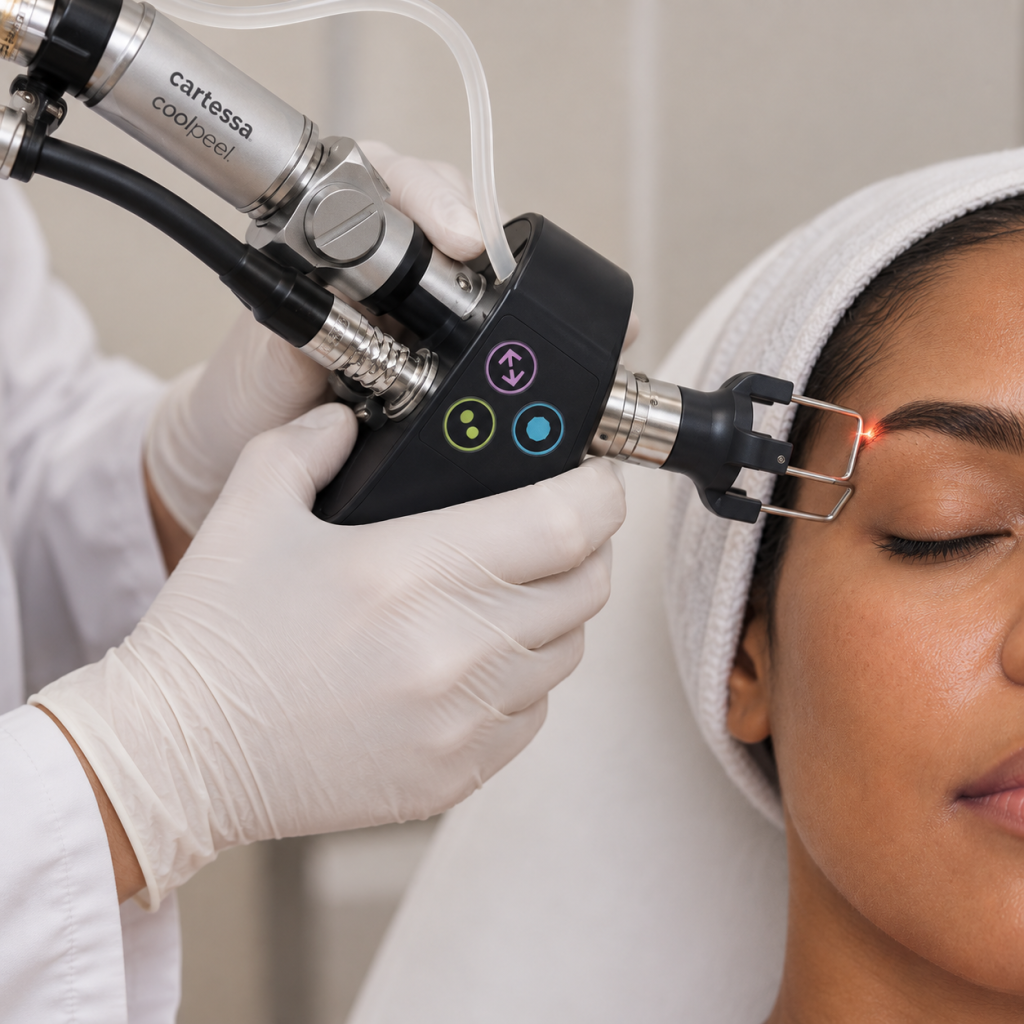
For years, people with darker skin tones have often been told that CO2 laser is simply not suitable for them. The reality is more nuanced. So, can darker skin have CO2 laser?
In selected patients, fractional CO2 laser may be considered for darker skin, but treatment requires considerably more caution. Higher levels of melanin can make the skin more susceptible to pigment changes following inflammation, particularly post-inflammatory hyperpigmentation (PIH). This means the decision is not based on skin colour alone; the patient’s skin type, pigmentation history, treatment indication and the laser settings all matter.
At SRGN, Mo Harb believes the question should never simply be whether someone has “dark” or “light” skin. The important question is how that individual’s skin is likely to respond to controlled laser injury.
CO2 is an ablative laser. It works by targeting water within the skin and creating controlled thermal injury, triggering a healing response and stimulating the remodelling of collagen.
That controlled injury is precisely what makes CO2 resurfacing effective, but inflammation can also stimulate melanocytes, the cells responsible for producing melanin.
Darker skin contains more active melanin production, which means inflammation or injury can be followed by areas of increased pigmentation.
Mo explains:
“Having darker skin doesn’t automatically exclude somebody from laser treatment. What changes is how carefully we have to assess the skin and how much controlled inflammation we are prepared to create.”
This is particularly important for anyone who already has a tendency to develop dark marks following acne, cuts, burns or other skin inflammation.
Post-inflammatory hyperpigmentation, commonly called PIH, occurs when the skin produces excess pigment following inflammation or injury.
It can appear as brown, grey or darker patches in the treated area and is generally more common and persistent in melanin-rich skin.
CO2 laser deliberately creates a controlled wound in the skin, so PIH is an important consideration when treating darker skin tones.
Mo says:
“One of the things I want to know during consultation is what happens to your skin when it becomes inflamed. If a spot, scratch or previous treatment leaves pigmentation for months, that’s important information when we’re deciding whether CO2 is appropriate.”
Potentially, yes, but not every patient with darker skin will be a suitable candidate.
Fractional CO2 differs from traditional fully ablative resurfacing because it treats microscopic columns of skin while leaving surrounding areas untreated. This fractional approach allows the untreated tissue to contribute to the healing process.
Published research has demonstrated that fractional CO2 can be used in some darker skin types, including for acne scarring, when conservative treatment parameters are selected. However, pigmentary complications remain an important risk.
The decision therefore needs to be made individually rather than assuming that a particular ethnicity or skin colour automatically determines suitability.
With laser treatment, stronger does not necessarily mean better.
Energy, density, pulse characteristics, number of passes and treatment depth all influence how much inflammation is created within the skin.
Research into fractional CO2 treatment of acne scars in skin of colour has highlighted the importance of more conservative parameters, including lower fluence and lower treatment density, to reduce complications while still stimulating remodelling.
Mo explains:
“The objective isn’t to use the strongest possible setting. It’s to create enough controlled stimulation to achieve a meaningful result without overwhelming the skin’s ability to heal well.”
This is why copying the same CO2 protocol across every skin type would be inappropriate.
Where clinically appropriate, fractional CO2 laser may be considered for concerns including acne scarring, uneven skin texture, enlarged pores, fine lines and certain types of scarring.
However, the concern being treated matters just as much as skin tone.
For example, someone seeking treatment for textural acne scar removal presents a different clinical problem from someone whose main concern is pigmentation or melasma. CO2 laser is not automatically the appropriate pigmentation treatment simply because it can resurface the skin.
This is where careful diagnosis becomes particularly important.
Not all pigmentation is the same. Sun damage, post-inflammatory pigmentation and melasma behave differently, and treatments that improve one type of pigmentation can potentially aggravate another.
In particular, ablative laser treatment can trigger inflammation, which may worsen pigmentary problems in susceptible darker skin.
Mo explains:
“Before treating pigmentation, you need to understand why that pigment is there. Treating the colour without understanding the cause can sometimes make the problem more difficult rather than better.”
For patients primarily concerned about pigmentation, another laser or skin treatment may therefore be more appropriate than CO2.
The Fitzpatrick scale categorises skin according to how it responds to ultraviolet exposure, ranging from Type I through to Type VI.
It can be useful when planning laser treatment, but it should not be the only assessment.
Two people who appear to have a similar skin tone may have very different histories of tanning, pigmentation, scarring and inflammatory responses.
This is why a detailed consultation is particularly important before CO2 treatment in darker skin.
For selected patients, a practitioner may recommend a period of skin preparation before laser treatment.
The exact approach depends on the patient’s skin, existing pigmentation and medical history. Sun exposure should also be carefully managed before and after resurfacing because UV exposure can increase the likelihood of unwanted pigmentation.
Preparation is not a guarantee that PIH will not occur, but appropriate patient selection, conservative treatment planning and careful aftercare can all form part of reducing avoidable risk.
Being unsuitable for CO2 does not mean that nothing can be done.
There are other technologies and treatment approaches that may be more appropriate for darker skin, depending on whether the concern is scarring, pigmentation, texture, laxity or general skin quality.
The purpose of a consultation should therefore be to identify the safest effective treatment for the individual rather than trying to make one particular device suitable for everyone.
As Mo puts it:
“Sometimes the right decision is to use CO2 more conservatively, and sometimes the right decision is not to use CO2 at all. Good treatment planning is knowing the difference.”
Yes, some people with darker skin can have fractional CO2 laser treatment, but suitability cannot be determined by skin colour alone.
Melanin-rich skin can be more susceptible to post-inflammatory pigmentation following procedures that create significant inflammation. For that reason, the patient’s skin type, previous pigmentation, scarring history, treatment objective and expected healing response all need to be considered before treatment.
The key message from Mo Harb is simple: darker skin should not automatically be excluded from advanced laser treatments, but neither should the additional risks be ignored.
When treating darker skin with CO2 laser, careful assessment, appropriate settings and realistic expectations are every bit as important as the technology itself.
CO2 laser resurfacing creates controlled injury in the skin, so it involves more downtime than many non-ablative treatments. Redness, swelling, sensitivity, peeling and temporary changes in pigmentation can occur during healing. There is also a risk of post-inflammatory hyperpigmentation, particularly in darker skin tones. Less common complications include infection and scarring, which is why appropriate patient selection, laser settings and aftercare are important.
CO2 laser is generally approached with caution in people with melasma. Heat and inflammation can stimulate melanocytes and potentially trigger or worsen pigmentation, particularly in susceptible skin. Having melasma does not necessarily rule out every laser treatment, but CO2 may not be the most appropriate option. The type, depth and triggers of the pigmentation should be assessed before deciding on treatment.
CO2 laser may not be appropriate for people with active skin infections, open wounds, certain inflammatory skin conditions or a history of poor wound healing or abnormal scarring. Extra caution is also required for patients prone to post-inflammatory hyperpigmentation, those with melasma and some darker skin types. Suitability should be assessed individually, taking into account skin type, medical history, pigmentation tendency and the concern being treated.
