Posted on 7 September 2026
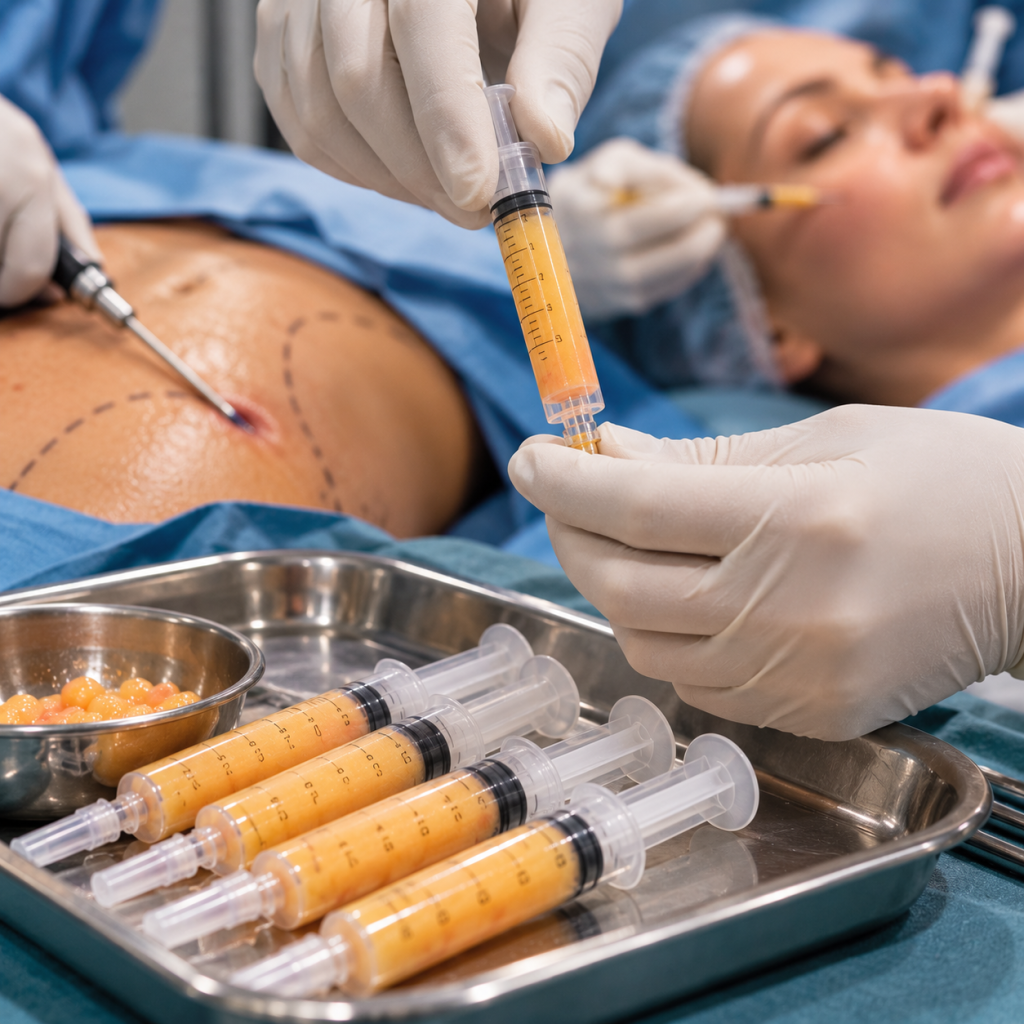
Autumn has traditionally been the season when aesthetic treatment plans shift away from maintaining summer skin and towards deeper rejuvenation. But for patients thinking beyond injectables, there is another approach that can address two very different concerns within the same procedure: unwanted pockets of body fat and age-related facial volume loss.
This is where micro-lipo combined with facial fat transfer becomes interesting. A relatively small amount of fat is removed from an appropriate donor area, such as the waist, abdomen or flanks, carefully processed and then transferred to areas of the face that have lost volume. For Dr Ayad Harb, the appeal lies in using the patient’s own tissue to restore facial structure while simultaneously refining the area from which the fat was taken.
The phrase “feeds your face” is, of course, figurative. Fat transfer does not nourish the face in the way food nourishes the body. Instead, it replaces some of the soft-tissue volume that naturally changes with age, using living fat harvested from elsewhere on the body.
“Micro-lipo” is commonly used to describe a smaller, more targeted liposuction procedure rather than extensive body contouring. In the context of facial fat transfer, the objective is often to harvest enough suitable fat for facial rejuvenation while creating a subtle improvement in the donor area at the same time.
Dr Ayad explains that this should not be confused with a major liposuction procedure intended to dramatically change someone’s waistline. Facial fat grafting generally requires comparatively modest volumes of fat, so any slimming effect depends on how much tissue is removed, the donor area and the individual’s starting anatomy.
The advantage is that the fat being removed does not necessarily need to be discarded. Once appropriately harvested and prepared, selected fat can be transferred into areas of facial volume loss. Modern facial fat-grafting techniques can use different forms of processed fat, including microfat, depending on the depth and area being treated.
When people first notice facial ageing, they often focus on lines. However, Dr Ayad emphasises that ageing occurs at several anatomical levels, and changes in facial fat are an important part of that process.
The cheeks can become flatter, the temples may appear more hollow and the transition between different areas of the face can become less smooth. Changes in the distribution and position of facial volume can also make other features, including lines and folds, appear more pronounced.
This is why simply treating the surface of the skin cannot always recreate youthful facial proportions. Fat transfer allows volume to be restored at selected depths, helping to address areas of deflation rather than concentrating only on individual wrinkles. Contemporary reviews continue to recognise restoration of facial soft-tissue volume as an important component of facial rejuvenation.
The process begins by identifying an appropriate donor area. Depending on the individual, this may include the abdomen, waist, flanks or thighs. Fat is removed through liposuction and then prepared before being introduced into carefully selected areas of the face.
Dr Ayad explains that facial fat transfer is not simply a matter of removing fat from one place and injecting it into another. Harvesting technique, processing, the size of the fat parcels, injection depth and the vascularity of the recipient tissue can all influence the final result.
The fat is therefore introduced strategically in small amounts across the appropriate tissue planes. This maximises contact between the grafted fat and healthy surrounding tissue while allowing the clinician to build facial volume gradually rather than creating an overfilled appearance.
Fat transfer can be considered when ageing has created genuine volume loss rather than simply a surface line. The midface and cheeks are particularly important because changes in these areas can influence the appearance of the entire face.
The temples and areas around the eyes may also lose volume with age, although these regions require particularly detailed anatomical knowledge because of the underlying vascular structures. A 2026 review of fat grafting around the midface and periorbital region describes autologous fat as an established approach for addressing age-related volume depletion and discusses increasingly refined harvesting and injection techniques.
For Dr Ayad, the aim is not to place fat everywhere. Treatment should restore what has been lost while respecting the person’s existing facial structure. The result should make the face appear less depleted rather than noticeably augmented.
Dermal filler and fat transfer are both used for facial volume restoration, but they are not interchangeable treatments. Dermal filler can be extremely precise and is useful when relatively small structural adjustments are required. Fat transfer becomes particularly interesting when broader areas of facial volume loss need to be addressed or when a patient prefers an autologous approach using their own tissue.
Once transferred fat successfully establishes itself within its new location, the retained portion can remain for years. However, Dr Ayad is careful to explain that not all transferred fat survives, and retention cannot be predicted with complete accuracy.
A systematic review involving more than 1,000 patients found reported facial fat-retention rates ranging from 26% to 83%, with an overall pooled retention of approximately 47%. This wide range illustrates why clinicians should never promise that a fixed percentage of transferred fat will remain.
The first months after fat transfer are important because the graft is adapting to its new environment. Some of the transferred volume will naturally be lost, while the portion that successfully establishes a blood supply becomes part of the surrounding tissue.
This is why the appearance immediately after treatment should not be interpreted as the final result. Initial swelling also contributes to early volume, and the face gradually settles as swelling reduces and the retained fat stabilises.
Long-term research shows that facial fat can remain years after treatment, but it continues to behave like living fat. A five-year study published in 2025 found persistent facial volume following fat grafting, while also showing that longer-term volume was influenced by changes in body weight.
The primary objective of facial fat transfer is volume restoration, but interest in fat grafting has expanded beyond filling alone. Different forms of processed autologous fat are now used according to what the clinician is trying to achieve. Research reviews describe macrofat and microfat as useful for restoring facial volume, while more refined fat preparations have also been studied for their effects on skin texture and quality.
For Dr Ayad, this is another reason fat transfer can form part of a more comprehensive rejuvenation strategy. Facial ageing is not purely a problem of wrinkles or lost volume; skin quality, tissue thickness and structural support all interact with one another. That does not mean fat transfer should be marketed as a treatment capable of regenerating every aspect of ageing skin. Its principal role remains the restoration of appropriately selected volume.
It can improve the contour of the donor area, but expectations need to remain realistic. If a small amount of fat is being harvested specifically for facial transfer, the body-contouring effect may be subtle. Someone wanting significant reduction around the abdomen or waist would require a different liposuction plan from someone who simply needs enough fat harvested for facial rejuvenation.
Dr Ayad therefore considers the donor site separately from the face. The ideal area needs to provide suitable fat while also allowing the extraction to be performed in a way that maintains smooth body contours. The concept is not to remove as much fat as possible simply because it can then be transferred. Both the donor site and the face should look proportionate after treatment.
There is no biological rule stating that facial fat transfer works better in autumn. The season itself does not make grafted fat more likely to survive. The practical appeal of autumn is different. Many patients have finished their summer travel and are spending less time in intense sunlight, while cooler clothing can make swelling or compression garments associated with body procedures easier to accommodate discreetly.
It also provides a period in which the body and face can settle before the end-of-year social season. For Dr Ayad, however, the correct timing should always depend on the patient’s health, schedule and treatment plan rather than the calendar alone. Autumn is convenient for many patients; it is not a biological requirement.
Using the patient’s own fat can sound extremely natural, but that should not make the procedure seem trivial.
Facial fat grafting requires detailed knowledge of facial anatomy. Although complications are uncommon overall, serious vascular complications have been reported, particularly in anatomically sensitive regions such as the forehead and temples. A systematic review of reported complications emphasised that facial fat grafting should be performed by appropriately qualified doctors with careful consideration of injection anatomy and technique.
Dr Ayad therefore sees assessment and technique as fundamental. The fact that the material comes from your own body does not remove the need for careful surgical planning.
For Dr Ayad Harb, one of the strongest advantages of fat transfer is that it allows facial ageing to be approached in three dimensions. Rather than chasing each individual line, the clinician can look at where the face has genuinely lost softness, support and proportion. Fat can then be restored selectively, allowing facial contours to be rebuilt without attempting to change the person’s underlying identity.
The donor site creates another opportunity. When fat is already being removed from an area such as the waist or abdomen, carefully planned extraction can subtly refine that contour while providing the material required for facial restoration. The two outcomes are connected, but they should never compete with one another. The waist should not be overtreated simply to obtain more facial fat, and the face should not receive more volume simply because additional fat is available.
How Autumn Micro-Lipo Feeds Your Face While Slimming Your Waist** is ultimately about using the same tissue intelligently in two different areas of the body. Targeted liposuction can harvest fat from an appropriate donor area while creating a degree of contour improvement. That fat can then be processed and carefully transferred into facial areas affected by age-related volume loss.
For Dr Ayad Harb, the attraction is not simply that the treatment uses the patient’s own fat. It is the ability to restore facial volume according to anatomy while avoiding the temptation to treat every sign of ageing with another injectable product.
Not every transferred fat cell will survive, and not every patient needs or is suitable for facial fat transfer. But when the procedure is properly planned, the fat that once contributed to an unwanted pocket around the body can potentially become part of a subtler, softer restoration of the face. It is less about moving fat from somewhere you do not want it to somewhere you do. It is about understanding where volume belongs.
Yes, small-volume liposuction techniques can be used on carefully selected areas of the face, particularly beneath the chin or along the jawline where there is localised fat. However, facial liposuction is very different from facial fat transfer. Liposuction removes unwanted fat, while fat transfer uses harvested fat to restore volume elsewhere. Suitability depends on skin elasticity, facial anatomy and the amount of fat present.
Liposuction can create a slimmer-looking waist by removing localised fat from areas such as the abdomen and flanks. The aim is body contouring rather than weight loss, so the result depends on the patient's starting shape, skin quality and how much fat can be safely removed. In some cases, treating the flanks as well as the waist can create a more defined silhouette.
There is no fixed number of inches that liposuction will remove from the waist. The change depends on how much fat is present, the areas treated, skin elasticity and the amount that can be removed safely. Some patients may notice a clear reduction in circumference, while others experience a more subtle contouring effect. Final measurements should only be assessed once swelling has settled and the tissues have fully recovered.
