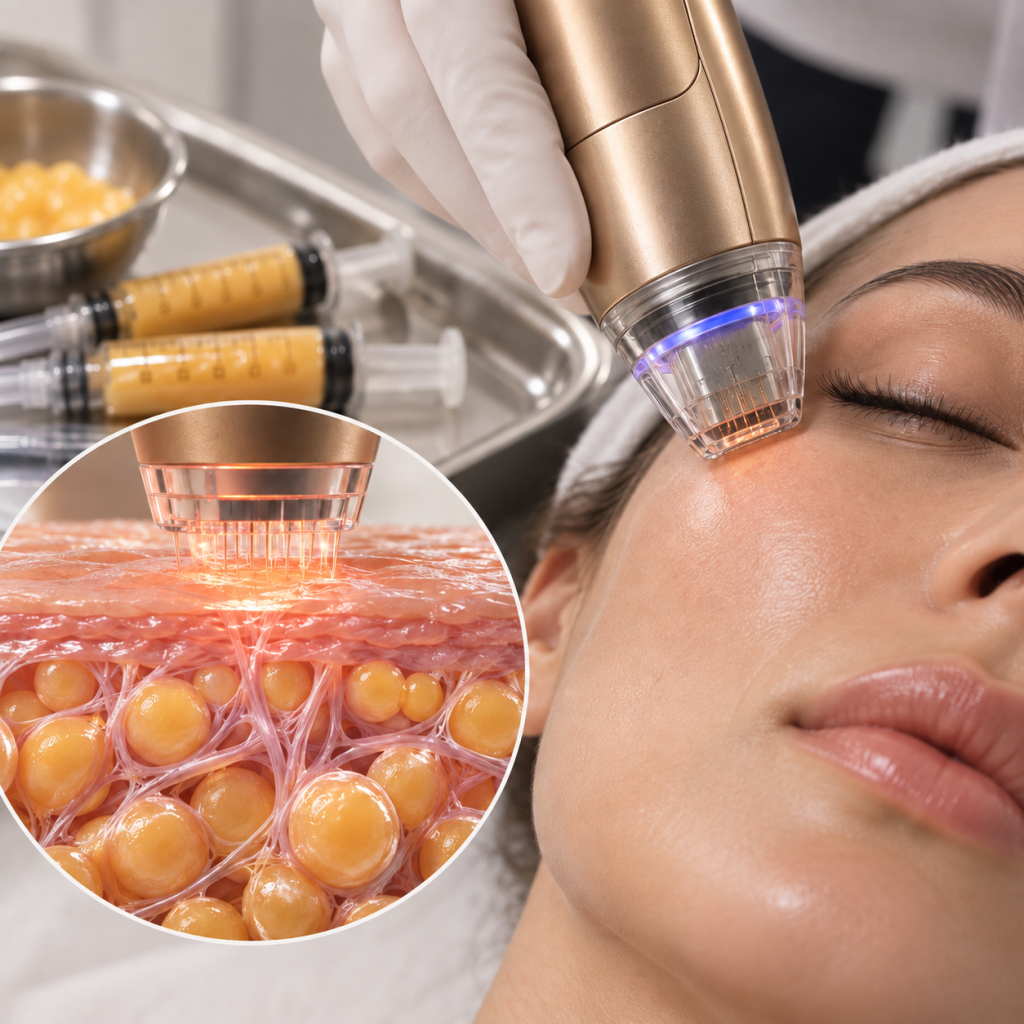
Fat transfer is one of the most natural ways to restore facial volume because the material being transferred comes from your own body. But there is one aspect of the procedure that makes it very different from dermal filler: not every transferred fat cell will necessarily survive. Once fat has been carefully harvested and transferred to another area of the face, it needs to establish itself within its new environment. The quality and vascularity of the recipient tissue therefore matter.
This has created increasing interest in a concept known as recipient-site preconditioning: preparing the tissue before fat transfer with the aim of creating a healthier environment for the graft. One approach being explored is microneedling. At our clinic, Sylfirm X can form part of a broader skin-conditioning strategy because it combines controlled microneedling with radiofrequency energy to stimulate tissue remodelling and collagen production.
The science is promising, but the distinction is important. Research has investigated conventional microneedling as a method of improving fat-graft retention. It has not yet been established that Sylfirm X itself directly increases the percentage of transferred fat that survives. So why combine the two?
Fat transfer involves removing fat from one area of the body, processing it and carefully introducing small amounts into another area. Once transferred, the graft initially has no independent blood supply. The fat cells rely on the surrounding recipient tissue while new vascular connections develop. This early period is one of the reasons technique matters so much.
Fat is normally placed in small amounts across multiple tissue planes so that as much of the graft as possible remains in close contact with healthy, vascularised tissue. Even with meticulous technique, retention can vary between individuals. Research into facial fat grafting has shown considerable variation in the amount of transferred volume that remains over time, which is why responsible fat-transfer treatment can never guarantee that 100% of the graft will survive. The condition of the recipient tissue is therefore receiving increasing attention alongside the way fat is harvested and transferred.
Recipient-site preconditioning means preparing the area that will receive the fat before the transfer takes place. The theory is relatively straightforward. A healthier, well-vascularised tissue environment may provide more favourable conditions for transplanted fat during the critical early period after treatment. Researchers have investigated several ways of preparing recipient tissue, including mechanical stimulation and microneedling.
An experimental study examining microneedling before fat grafting found greater vascularity, better graft integrity and higher fat survival in preconditioned tissue. Later clinical research comparing facial fat grafting with and without adjunctive microneedling also reported better improvements in volume and skin quality in the group receiving microneedling. These findings are interesting because they suggest that preparing the recipient tissue may be just as important as concentrating solely on the transferred fat.
However, this research needs to be interpreted carefully. The early study was performed in an animal model, while the subsequent human study was relatively small. Neither investigated Sylfirm X specifically.
Sylfirm X combines microneedling with controlled bipolar radiofrequency energy. The fine needles create controlled stimulation within the skin, while radiofrequency energy is delivered at selected depths according to the concern being treated. This triggers a wound-repair response associated with collagen remodelling and changes within the dermal tissue.
For us, the reason Sylfirm X is interesting around fat-transfer planning is not simply that it “tightens the skin”. We are considering the quality of the recipient tissue. If fat transfer is being used to restore volume while the overlying skin is thin, lax or texturally damaged, addressing only the volume may not provide the most complete rejuvenation. Improving the skin and restoring deeper volume are two different objectives. Sylfirm X can therefore be considered as part of a staged treatment strategy designed to improve the condition of the skin surrounding the area being treated.
This is where we need to separate a plausible biological theory from something that has been conclusively demonstrated. Conventional microneedling has been associated experimentally with increased vascularity in preconditioned tissue, and improved vascularisation is one proposed explanation for the increased fat-graft survival observed in early research.
Sylfirm X also creates controlled microneedling injury while introducing radiofrequency energy, but it should not automatically be assumed that the results from conventional microneedling studies apply identically to RF microneedling.
There are differences in the way the treatments interact with tissue. For that reason, we would not describe Sylfirm X as clinically proven to increase fat-transfer survival by a particular percentage. Instead, its role is better understood as part of a tissue-conditioning approach that aims to improve skin quality and create a favourable environment around a planned facial rejuvenation procedure.
Combining technologies does not mean performing every treatment at the same appointment. Fat that has recently been transferred is undergoing a delicate process of incorporation into the surrounding tissue. Radiofrequency produces controlled thermal energy, so treatment over newly grafted fat needs particularly careful consideration. The sequence, treatment depth, energy settings and interval between procedures should therefore be decided by the clinician performing the fat transfer.
This is an important principle in combination aesthetics. More stimulation does not automatically mean better fat survival. The aim is to prepare and improve the recipient tissue without unnecessarily disturbing the graft during the period when it is establishing itself.
One of the strongest reasons to consider the treatments together is actually unrelated to graft survival alone. Facial ageing occurs at several anatomical levels. The face can lose volume as deeper fat compartments change, while the skin simultaneously becomes thinner, less elastic and more visibly lined.
Fat transfer addresses volume. Sylfirm X addresses skin quality, laxity and dermal remodelling. Treating one without considering the other can sometimes leave part of the ageing process unaddressed.
For example, restoring cheek volume may improve facial contours, but it will not necessarily correct fine surface texture or declining skin firmness. Equally, improving skin quality with RF microneedling cannot replace meaningful volume loss. When used strategically, the treatments therefore complement rather than duplicate one another.
Fat transfer is a biological treatment, and biology varies from patient to patient. Research analysing facial fat grafting has found substantial variation in long-term volume retention. Factors including the recipient area, vascularity, surgical technique, the volume transferred and individual healing can all influence the outcome. That means claims such as “90% fat survival” should be approached carefully unless they relate to a clearly defined clinical study and technique.
Even research investigating methods intended specifically to improve fat retention has produced variable results. A recent randomised clinical trial examining other methods of recipient-site preconditioning in fat transfer did not find a statistically significant increase in graft retention, illustrating why promising biological theories still need robust clinical evidence before they can be treated as established fact.
The most interesting aspect of combining fat transfer with advanced skin technology may ultimately be the ability to rejuvenate different layers of the face. Fat transfer can restore softness, proportion and volume using a patient’s own tissue. Sylfirm X can address aspects of skin laxity, texture and collagen remodelling. Microneedling research also gives us an emerging scientific rationale for considering the health of the recipient tissue before fat is transferred. This creates a more sophisticated approach than simply adding volume to an ageing face.
How We Use Sylfirm X to Boost Fat Transfer Survival Rates is therefore really about optimising the environment in which facial fat transfer takes place. Research suggests that microneedling preconditioning may improve vascularity and fat-graft retention, but there is not yet sufficient evidence to say that Sylfirm X specifically increases graft survival or to promise a particular improvement in retention.
What Sylfirm X can contribute is controlled tissue stimulation, collagen remodelling and improvement in the quality of the skin surrounding the areas being rejuvenated. Used as part of a carefully staged treatment plan, this allows us to think beyond simply transferring fat. We can consider the condition of the tissue receiving it, the quality of the overlying skin and how each layer of the face contributes to the final result. That is ultimately the purpose of combination treatment: not to do more, but to make each part of the treatment plan work intelligently alongside the others.
Fat retention after facial fat transfer varies considerably. Research has reported retention rates ranging from approximately 26% to 83%, with a pooled average of around 47% in one systematic review. Some of the transferred fat is naturally reabsorbed during the first few months, while the portion that successfully establishes a blood supply may remain long term. Technique, treatment area, individual healing and changes in body weight can all influence the final result.
Fat that successfully establishes itself following breast fat transfer can remain for many years and behaves much like the surrounding natural fat. The breasts will still change with ageing, weight fluctuations, pregnancy and hormonal changes. Long-term research is more limited than short-term data, but studies have found that results can remain stable for several years once the initial fat resorption has settled. Additional fat transfer may sometimes be required to maintain or increase volume.
Facial fat transfer can still provide volume after five years, although the amount retained varies between individuals. A 2025 study following patients for five years confirmed persistent facial volume, but long-term volume was strongly influenced by changes in body weight. Natural facial ageing also continues after treatment, so some patients may choose further fat transfer or complementary treatments over time rather than expecting one procedure to permanently stop age-related volume changes.
