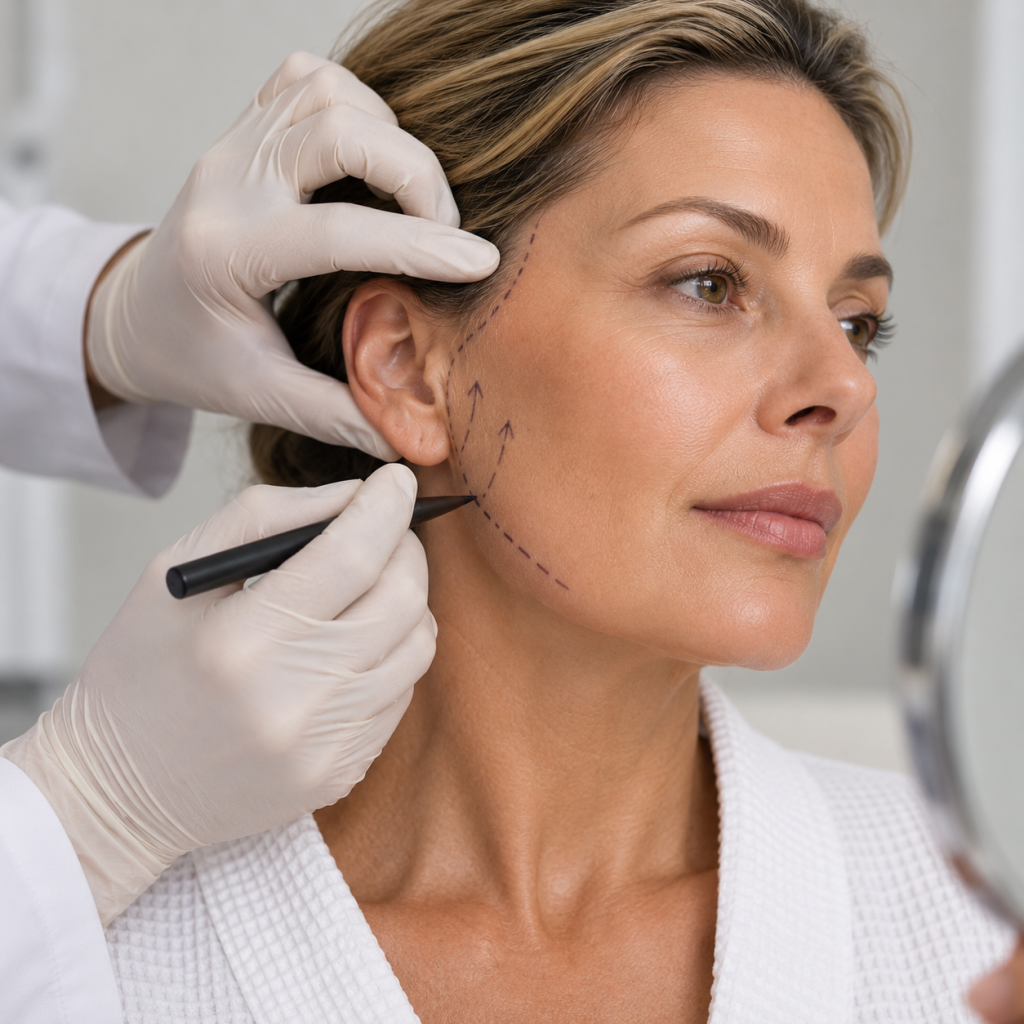
If you are considering facial surgery but feel apprehensive about the recovery, one of your first questions may be: is a mini facelift painful?
The reassuring answer is that a mini facelift should not be painful during the procedure because appropriate anaesthesia is used. Afterwards, some discomfort, tightness, swelling and tenderness are expected, particularly during the early stages of healing. However, patients often describe the sensation as tightness or soreness rather than severe pain.
At our clinic, Dr Ayad Harb performs mini facelift surgery with an emphasis on achieving natural facial rejuvenation through the least invasive procedure capable of addressing the patient’s concerns.
A mini facelift is a surgical procedure designed to improve early to moderate signs of ageing affecting the lower face and jawline.
As we age, changes occur at several levels of the face. Skin elasticity decreases, deeper supporting tissues become less firm and facial volume changes. Together, these processes can contribute to jowling, reduced jawline definition and sagging around the lower face.
A mini facelift allows the surgeon to reposition and support these tissues through smaller, carefully placed incisions, typically around the ear.
Dr Ayad explains:
“A mini facelift isn’t about pulling the face tight. The aim is to restore support where ageing has changed the tissues, while keeping the patient’s expressions and facial character completely recognisable.”
No. You should not experience surgical pain while the mini facelift is being performed.
At our clinic, Dr Ayad performs mini facelift surgery under local anaesthetic, meaning the treatment area is numbed while the patient remains awake.
The injections used to administer the local anaesthetic can cause brief stinging or discomfort. Once the area is fully numb, patients may remain aware of movement, pressure or touch, but should not experience sharp surgical pain.
Dr Ayad says:
“Patients are often surprised by how comfortable the procedure itself can be. Being awake doesn’t mean feeling the surgery. Local anaesthetic allows us to thoroughly numb the treatment area while avoiding the need for a general anaesthetic.”
Once the local anaesthetic begins to wear off, it is normal to experience some discomfort.
Rather than significant pain, many patients notice sensations such as tightness around the jawline, tenderness near the incisions, swelling, bruising or temporary numbness.
The face may initially feel unusually tight because tissues have been repositioned and swelling is present. This sensation gradually settles as healing progresses.
Everyone experiences discomfort differently, so it is impossible to predict exactly how a mini facelift will feel for an individual patient.
The first few days after surgery are generally when swelling, tightness, and tenderness are most noticeable.
These symptoms should progressively improve rather than become more severe.
Dr Ayad explains:
“Recovery isn’t completely sensation-free, and I think it’s important to be realistic about that. There will be swelling and tightness, particularly initially, but severe or worsening pain isn’t something a patient should simply ignore.”
Patients receive specific postoperative instructions and guidance on appropriate pain relief following surgery.
Postoperative discomfort can usually be managed with the pain relief recommended by your surgical team.
Keeping the head elevated during the early recovery period can also help manage swelling. Patients should avoid strenuous exercise, heavy lifting and activities that increase pressure or blood flow to the face until advised that it is safe to resume them.
Following the surgeon’s aftercare instructions is important both for comfort and appropriate healing.
You should not take additional medication or supplements without checking whether they are suitable around the time of surgery.
The term “mini” refers to the extent and approach of the procedure rather than guaranteeing a completely painless or minimal recovery.
A mini facelift generally involves a more limited area of surgical dissection than a more extensive facelift. For appropriately selected patients, this can mean a more manageable recovery.
However, the correct procedure should not be selected simply according to which one sounds easier.
Dr Ayad explains:
“My philosophy is to recommend the least invasive procedure that can genuinely achieve the patient’s goals. There is no benefit in performing more surgery than someone needs, but equally, a smaller operation needs to be capable of addressing the problem.”
This is why patient selection is particularly important.
Facial tightness is expected during the early stages of recovery and does not necessarily indicate that something is wrong.
Swelling gradually decreases over the following weeks, while deeper tissues continue healing for considerably longer. Temporary numbness or altered sensation around the incisions can also occur.
The face may therefore feel different before it begins to feel completely normal again.
Recovery should be viewed as a gradual process rather than expecting the face to look and feel settled immediately after surgery.
Some swelling and bruising are normal following facial surgery.
How noticeable they are varies considerably between patients. Individual healing response, the extent of surgery and adherence to postoperative advice can all influence recovery.
Early swelling can temporarily distort the result, so judging the appearance of a facelift during the first few days is rarely helpful.
As swelling subsides, the new contours of the lower face and jawline gradually become clearer.
Patients should allow themselves time to recover even though the procedure is described as a mini facelift.
There will be an initial period of swelling, bruising and tightness, followed by gradual improvement. Incisions also need time to mature and become less noticeable.
Dr Ayad says:
“I always remind patients that surgery is an event, but healing is a process. The result doesn’t appear overnight. We want the tissues to settle naturally rather than judging the face while it is still swollen.”
Your individual recovery timeline will be discussed during consultation and reviewed during postoperative appointments.
Some soreness and tenderness are expected, but significant or rapidly worsening pain should be reported to your surgical team.
Patients should also seek advice if they develop symptoms such as rapidly increasing swelling, significant asymmetry, persistent bleeding, fever, unusual discharge or other unexpected changes.
Aftercare and access to the surgical team are therefore important considerations when choosing where to undergo facelift surgery.
This is an understandable concern for patients considering surgery under local anaesthetic.
Although you remain awake, the surgical area is numbed. You may be aware that something is happening, but you should not feel the surgical procedure as painful.
For some patients, avoiding general anaesthesia is one of the reasons they are interested in a mini facelift. Others may initially feel nervous about being awake.
Discussing these concerns openly with your surgeon before treatment can help you understand exactly what to expect.
A mini facelift is surgery, so it would be unrealistic to describe the entire experience as completely pain-free. However, the procedure itself should not hurt once local anaesthetic has taken effect.
During recovery, patients should expect some tenderness, swelling and a feeling of tightness. For many, these sensations are more noticeable than actual pain and gradually improve as the tissues heal.
For Dr Ayad Harb, the decision to perform a mini facelift begins with whether it is genuinely the appropriate amount of surgery for the patient.
His approach at SRGN is to use the least invasive procedure capable of achieving the desired improvement, rather than performing a more extensive facelift simply because it is available.
For the right patient, that can mean meaningful improvement to the lower face and jawline while keeping both the procedure and recovery proportionate to what actually needs to be corrected.
A mini facelift is a surgical procedure and therefore carries risks, including bleeding, infection, scarring, temporary or persistent changes in sensation, asymmetry and, rarely, nerve injury or problems with wound healing. Risks vary according to the patient's health, anatomy and the surgical technique used. Choosing an appropriately qualified and experienced facial surgeon and following the recommended aftercare can help minimise avoidable complications.
Most swelling and bruising are most noticeable during the first days following a mini facelift and gradually improve over the following weeks. Many patients feel comfortable returning to normal social activities after around two weeks, although this varies. Residual swelling, tightness or numbness can take longer to settle, and the final result continues to refine over several months as the tissues heal.
There is no standard result based on age alone. A 60-year-old may have jowling, reduced jawline definition and loose lower-face skin before surgery. After a well-planned mini facelift, these areas can appear firmer and better defined while the face should remain recognisably their own. Suitability depends more on facial anatomy, skin quality and the degree of ageing than simply being 60.
