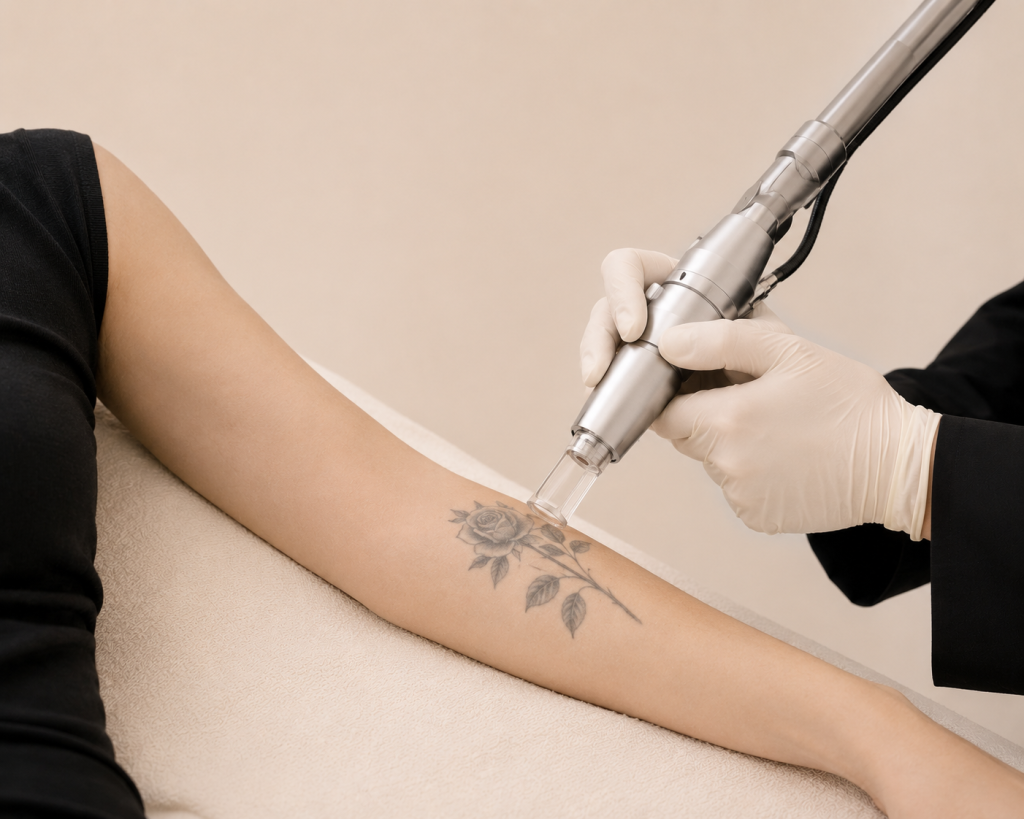
Deciding to remove a tattoo is often followed by another important question: where can I get a tattoo removed in Surrey?
There are many clinics offering laser tattoo removal across Surrey and the surrounding areas, but the technology used, practitioner experience, treatment planning, and aftercare can vary considerably. Because tattoo removal usually requires a course of sessions, choosing the right clinic from the beginning is an important part of the process.
For patients travelling from Surrey, SRGN offers laser tattoo removal at its Ascot clinic, where treatments are performed by Lana, an experienced laser therapist, using the PicoStar laser.
When searching for tattoo removal in Surrey, it is worth looking beyond which clinic is closest. Laser technology, practitioner experience, realistic treatment planning, and the ability to assess different tattoo colours and skin types can all influence the removal process.
Patients from Surrey looking for laser tattoo removal may consider travelling to SRGN in Ascot, particularly if they are looking for treatment using PicoStar technology.
Lana assesses each tattoo before treatment to consider factors such as its colour, age, location, density, and whether it was applied professionally or by an amateur.
Tattoo ink remains in the skin because the pigment particles are too large for the body to clear easily.
Laser tattoo removal works by delivering short pulses of energy into the tattoo pigment. This breaks the ink into smaller fragments, which can then be gradually processed by the body’s natural clearance mechanisms.
The tattoo does not disappear immediately after treatment. Instead, it usually fades progressively over the weeks following each session.
At SRGN, tattoo removal is performed using the PicoStar laser. This picosecond laser technology delivers ultra-short pulses of energy to break tattoo pigment into smaller particles.
The aim is to target the tattoo ink while limiting unnecessary exposure to the surrounding skin. Different tattoo colours can respond differently to laser treatment, which is why the tattoo should be assessed before a treatment plan is recommended.
According to Lana:
“No two tattoos fade in exactly the same way. The colour, depth of the ink, age of the tattoo, and how it was originally applied can all affect how it responds to treatment.”
There is no fixed number of sessions that will completely remove every tattoo.
Professional tattoos often contain more ink and may require more treatments than amateur tattoos. Certain colours can also be more resistant than others, while older tattoos may sometimes respond differently from newer ones.
The body’s own clearance process also plays an important role. This is why sessions need to be appropriately spaced rather than performed too frequently.
Lana explains:
“Patients often want to know exactly how many sessions they will need before they start, but tattoo removal is a gradual process. We can assess the tattoo and provide realistic guidance, but the response needs to be reviewed as treatment progresses.”
Laser tattoo removal can be uncomfortable, although the experience varies between individuals and according to the location and size of the tattoo.
Many people describe the sensation as a series of quick, sharp snaps against the skin. Treatments are generally relatively quick for smaller tattoos, although larger areas naturally take longer.
The sensation should be discussed during the consultation so that patients understand what to expect before beginning treatment.
Many tattoos can fade significantly with laser treatment, but complete removal cannot be guaranteed.
The final result depends on several factors, including the colours used, the depth and density of the pigment, the age of the tattoo, the individual’s skin, and the body’s response to treatment.
A responsible tattoo removal clinic should explain these variables clearly rather than promising that every tattoo will disappear completely.
When researching where can I get a tattoo removed in Surrey, look at the laser technology being used, the experience of the person performing the treatment, the consultation process, and the aftercare provided.
The clinic should assess your tattoo and skin before beginning treatment, explain the likely process clearly, and allow enough healing time between sessions.
Treatment should be based on how your tattoo responds rather than following the same standard plan for every patient.
For patients based in Surrey and the surrounding areas, SRGN’s Ascot clinic offers laser tattoo removal using PicoStar technology.
Treatments are performed by Lana, who assesses each tattoo individually and adapts the treatment plan according to the pigment, skin, and response over time.
Understanding where can I get a tattoo removed in Surrey is ultimately about finding a clinic that combines appropriate laser technology with experienced treatment planning and realistic expectations. Tattoo removal takes time, but with the right approach, unwanted ink can gradually become significantly lighter over the course of treatment.
The cost of laser tattoo removal in the UK varies depending on the size, colour, density, and location of the tattoo, as well as the number of sessions required. Smaller tattoos generally require shorter treatment appointments, while larger or more complex tattoos may need a longer course. A consultation and assessment are usually needed before an accurate treatment plan and total cost can be estimated.
The total cost of removing a tattoo depends on how the individual tattoo responds to laser treatment. Factors such as whether it is professional or amateur, the colours used, the depth of the ink, and the number of sessions required all influence the final cost. Because tattoo removal is a gradual process, an assessment is the best way to estimate the likely treatment course.
Some tattoos can become extremely faint or appear almost completely removed, but 100% clearance cannot be guaranteed. Results depend on the ink colours, pigment depth, tattoo age, skin type, and individual response to treatment. Black ink often responds well, while some colours may be more resistant. Modern picosecond laser technology can achieve significant fading, but every tattoo responds differently.
