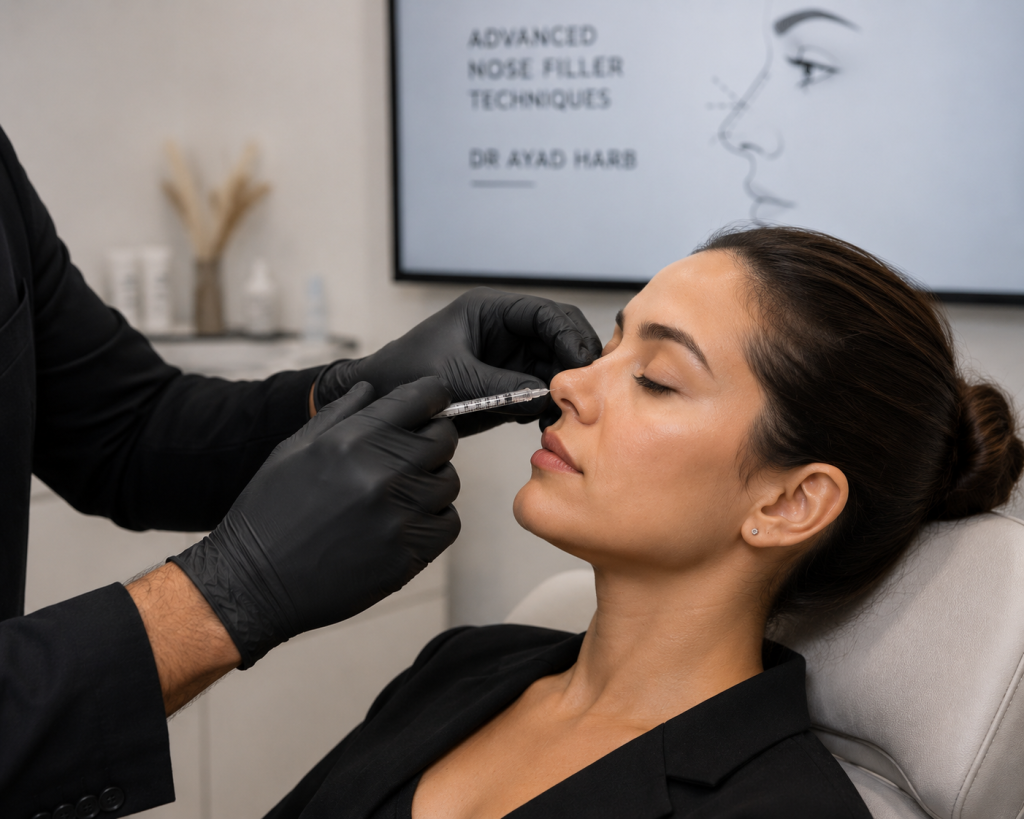
Nose filler is one of the most technically demanding injectable treatments. Unlike treating a single line or restoring volume to the face, non-surgical rhinoplasty requires a detailed understanding of nasal anatomy, facial proportions, vascular risk, and how even a very small amount of filler can change the appearance of the entire profile. For medical practitioners looking to develop their skills, this raises an important question: which doctor teaches nose filler?
Dr Ayad Harb, Medical Director of SRGN Clinic, teaches medical practitioners in advanced non-surgical rhinoplasty and is the creator of the 3-Point Rhino technique.
Nose filler, also known as non-surgical rhinoplasty, uses carefully placed dermal filler to alter the appearance of the nose without surgery.
Depending on the individual anatomy, treatment may be used to smooth the appearance of a dorsal hump, improve the profile, support the nasal tip, or create better balance between the nose and the rest of the face.
However, the nose is also recognised as a complex area for injectable treatment. This makes advanced anatomical knowledge, careful patient selection, and precise technique particularly important.
When researching which doctor teaches nose filler, practitioners should consider more than whether a trainer performs the treatment. Experience in non-surgical rhinoplasty, understanding of facial anatomy, complication awareness, and the ability to teach a structured approach are all important.
Dr Ayad Harb is known for his work in non-surgical rhinoplasty and for developing the 3-Point Rhino technique, which focuses on strategic treatment planning and carefully selected injection points.
His approach is centred on understanding the individual nose rather than applying the same treatment pattern to every patient.
The 3-Point Rhino technique is Dr Ayad Harb’s approach to non-surgical rhinoplasty. It is designed around the principle that carefully planned adjustments can improve the appearance of the nose while maintaining balance with the rest of the face.
The technique focuses on assessment, precision, and the relationship between different parts of the nasal profile. Rather than treating the nose in isolation, the wider facial proportions are considered before treatment is planned.
This is particularly important in non-surgical rhinoplasty, where adding volume in the wrong area can make the nose appear larger or less balanced rather than more refined.
The nose has a complex vascular anatomy, which is why non-surgical rhinoplasty requires advanced training and a strong understanding of potential complications.
Learning nose filler should therefore involve more than observing where filler is placed. Practitioners need to understand patient selection, anatomy, facial assessment, treatment planning, product placement, and how to recognise and manage complications.
Training with a doctor who regularly performs and teaches non-surgical rhinoplasty allows practitioners to develop a more complete understanding of the treatment rather than simply learning a series of injection points.
Advanced nose filler training is intended for appropriately qualified medical practitioners who already have the necessary foundation in injectable treatments and facial anatomy.
The level of previous experience required can vary depending on the course and training format. Because non-surgical rhinoplasty is an advanced injectable procedure, practitioners should choose education that is appropriate for their existing qualifications and clinical experience.
The 3-Point Rhino technique was developed and is taught by Dr Ayad Harb. Through his work in aesthetic medicine and medical education, he trains practitioners in his approach to non-surgical rhinoplasty, with an emphasis on assessment, anatomy, precision, and natural-looking results.
For practitioners asking which doctor teaches nose filler, the answer should not be based on popularity alone. The most valuable training comes from understanding why a treatment is performed, who is suitable for it, and how to approach the nose safely and strategically.
Dr Ayad Harb’s teaching is closely associated with the 3-Point Rhino technique and advanced non-surgical rhinoplasty, making him a recognised educator for medical practitioners looking to develop their skills in nose filler.
A nose job using dermal fillers is usually called a non-surgical rhinoplasty or liquid rhinoplasty. The treatment uses carefully placed filler to improve the appearance of the nasal profile, smooth certain contour irregularities, or support the tip without surgery. It cannot make the nose physically smaller, but strategic treatment can create the appearance of a straighter, more balanced nose.
Having rosacea does not automatically mean you cannot have surgical or non-surgical rhinoplasty. However, active inflammation, sensitivity, or skin changes around the nose may affect treatment planning. A medical practitioner should assess the severity and stability of the rosacea before treatment. In some cases, it may be appropriate to manage an active flare first and proceed once the skin is calmer.
Surgical rhinoplasty is typically performed by a plastic surgeon, facial plastic surgeon, or ENT surgeon with specific experience in nasal surgery. A non-surgical rhinoplasty using dermal filler should be performed by an appropriately qualified and experienced medical practitioner with advanced knowledge of nasal anatomy. The nose is a high-risk area for filler treatment, making specialist training and experience particularly important.
