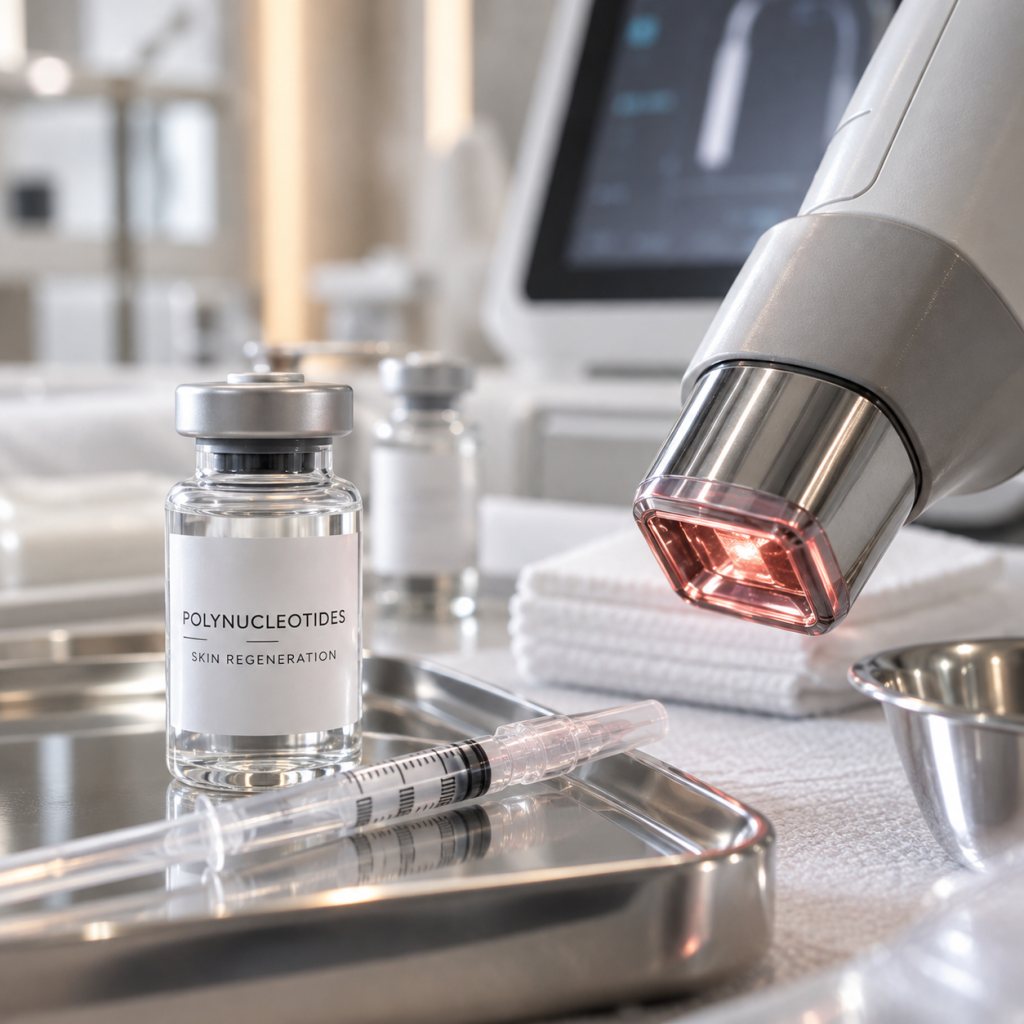
Skin ageing rarely has just one cause. Fine lines, uneven texture, pigmentation, enlarged pores, reduced elasticity and loss of hydration often develop together, yet they originate from different changes within the skin. This is why combining treatments can sometimes achieve a more complete result than relying on one technology alone. One combination attracting increasing interest is polynucleotides with advanced laser technology, particularly fractional CO2 laser treatment.
The two treatments have very different roles. CO2 laser creates controlled resurfacing and stimulates a repair response within the skin, while polynucleotides are used to support skin quality, hydration and regenerative processes. Rather than asking one treatment to do everything, the principle is to address the skin from different angles.
Fractional CO2 laser is an established resurfacing treatment used for concerns including lines, uneven texture, sun damage, certain types of pigmentation and acne scarring. The laser delivers controlled columns of energy into the skin while leaving surrounding areas untreated. This fractional approach allows the skin to begin repairing the treated areas while stimulating collagen remodelling beneath the surface.
The result is not simply exfoliation. CO2 laser produces a controlled wound-healing response, which is why improvements continue to develop after the initial recovery period. As collagen remodels, the skin can gradually appear smoother, firmer and more even in texture. Clinical reviews support fractional CO2 laser as an established option for facial rejuvenation, although treatment intensity, recovery and risk need to be considered carefully for each individual. However, resurfacing is only part of the ageing picture.
Skin can be smoother after laser treatment while still lacking hydration, elasticity or overall resilience. This is where regenerative injectable treatments can offer a complementary approach.
Polynucleotides are not dermal fillers and are not designed primarily to add volume or alter facial proportions. Their role is centred much more on skin quality. They are used to support hydration, elasticity and the biological environment involved in tissue repair and dermal remodelling. Research into polynucleotides has reported encouraging improvements in parameters including skin hydration, elasticity, texture and fine lines, although the current evidence base is still developing and treatment protocols are not yet completely standardised.
This makes the relationship with laser particularly interesting. CO2 laser deliberately creates controlled stimulation within the skin. Polynucleotides take a different approach, focusing on supporting the quality and condition of the tissue. One creates the stimulus for remodelling; the other may support the environment in which that remodelling takes place.
It is useful to think about the treatments as performing different jobs. Fractional CO2 laser primarily addresses the surface and deeper structural changes associated with photoageing and textural damage. It can be particularly useful for rough texture, established lines, acne scarring and visible sun damage. Polynucleotides are generally used when we want to improve how the skin itself looks and behaves, particularly when there is dehydration, fine creasing or reduced elasticity.
Combining these approaches therefore does not mean performing two versions of the same treatment. It means recognising that removing damaged surface tissue and improving skin quality are not necessarily the same thing. That distinction is increasingly important in modern aesthetic medicine.
This is an area of growing clinical interest. Recent research examining polynucleotide-related treatments in post-procedure recovery has reported encouraging findings around re-epithelialisation, erythema and tissue recovery after aesthetic procedures, including laser resurfacing. However, the evidence is still emerging, and larger, well-designed clinical studies are needed before universal protocols can be established.
That means the combination should not be described as a guaranteed way to make CO2 laser heal faster. Instead, polynucleotides can be considered as part of a broader regenerative treatment strategy where improving skin quality before or after resurfacing is appropriate. Importantly, combination treatment does not automatically mean both procedures should be performed at the same appointment.
The correct timing depends on the intensity of the laser treatment, the polynucleotide product being used, the condition of the skin and the patient’s individual healing response. Allowing the skin sufficient time to recover remains fundamental.
Fractional CO2 laser temporarily disrupts the skin barrier as part of the resurfacing process. Redness, swelling, dryness, flaking and sensitivity can therefore occur during recovery. Post-inflammatory pigmentation is also a recognised risk, particularly following more intensive treatment, making appropriate patient selection and aftercare extremely important. This is why we do not view combination treatment as simply layering procedures on top of one another.
More treatment does not automatically produce more regeneration. Depending on the skin, polynucleotides may form part of the preparation phase, the longer-term recovery strategy or a later treatment designed to continue improving skin quality once the initial laser healing period has passed. A carefully staged approach respects the biological recovery process rather than trying to accelerate it unnecessarily.
Long-term sun exposure affects the skin in several ways. It can contribute to pigmentation, uneven texture, collagen degradation, fine lines and a gradual reduction in elasticity. Consequently, correcting only one visible symptom may leave other signs of ageing unchanged. CO2 laser can be particularly effective when surface damage and texture are significant concerns.
Polynucleotides may then complement this by focusing on qualities such as hydration, elasticity and dermal condition. This is one of the reasons combination treatments have become increasingly important within regenerative aesthetics. Instead of choosing a procedure purely because it targets a wrinkle, the treatment plan considers what is happening throughout the skin.
Neither treatment should be described as producing perfect skin. After fractional CO2 laser, the initial improvement becomes more apparent once the skin has healed, while collagen remodelling can continue over the following months. Polynucleotide results are also gradual.
The objective is generally not a dramatic change in facial structure. Instead, the skin may progressively appear better hydrated, smoother and more resilient as the treatment course develops. This makes the combination particularly relevant for people who want improvement in the quality of their skin, rather than simply adding volume or changing facial features. It is also important to remember that results vary according to age, skin condition, sun exposure, treatment intensity and individual healing response.
No aesthetic laser should be approached as a universal treatment. Skin type, pigmentation tendency, medical history, existing inflammation, previous procedures and sun exposure all need to be considered before fractional CO2 laser is performed. More intensive resurfacing also means more recovery. Patients should therefore understand that CO2 laser is not a “no downtime” treatment. Redness and visible skin shedding are part of the expected recovery process, and careful post-treatment skin protection is important. Polynucleotides do not remove these considerations or make unsuitable skin suitable for aggressive resurfacing. Combination treatment still begins with appropriate patient selection.
Why We Combine Polynucleotides with Advanced Laser Tech ultimately comes down to treating different aspects of skin ageing rather than expecting one procedure to solve everything. Fractional CO2 laser is an established resurfacing technology that can improve texture, lines, scarring and visible photodamage by stimulating controlled skin renewal and collagen remodelling.
Polynucleotides approach skin rejuvenation differently. They are used to support hydration, elasticity and overall tissue quality, with emerging research suggesting a potential role within regenerative and post-procedure treatment strategies. When appropriately selected and carefully timed, the two approaches can therefore complement each other.
The aim is not to make the treatment more aggressive. It is to make the treatment plan more intelligent: resurfacing where the skin needs renewal, supporting skin quality where it needs regeneration, and allowing enough time for the biology of healing to do the rest.
One session of polynucleotides may produce a subtle improvement in hydration and skin quality, but the best results are usually seen after a course of treatments. Polynucleotides work gradually by supporting the skin’s regenerative processes, so changes in texture, elasticity and overall skin condition develop over time. The number of sessions needed depends on the treatment area, skin quality and the individual response.
Yes, microneedling and polynucleotides can be used as part of the same overall treatment plan, although the timing should be carefully considered. Microneedling creates a controlled repair response within the skin, while polynucleotides are used to support skin quality and regeneration. Depending on the skin and treatment protocol, they may be staged rather than performed together. An individual assessment is important to determine the safest and most appropriate approach.
Polynucleotides and skin boosters can be combined because they work in different ways. Skin boosters primarily focus on hydration and skin smoothness, while polynucleotides are used to support regenerative processes, elasticity and overall skin quality. They may be used in the same treatment plan, but not necessarily at the same appointment. The best combination and timing depend on the condition of the skin and the result being targeted.
