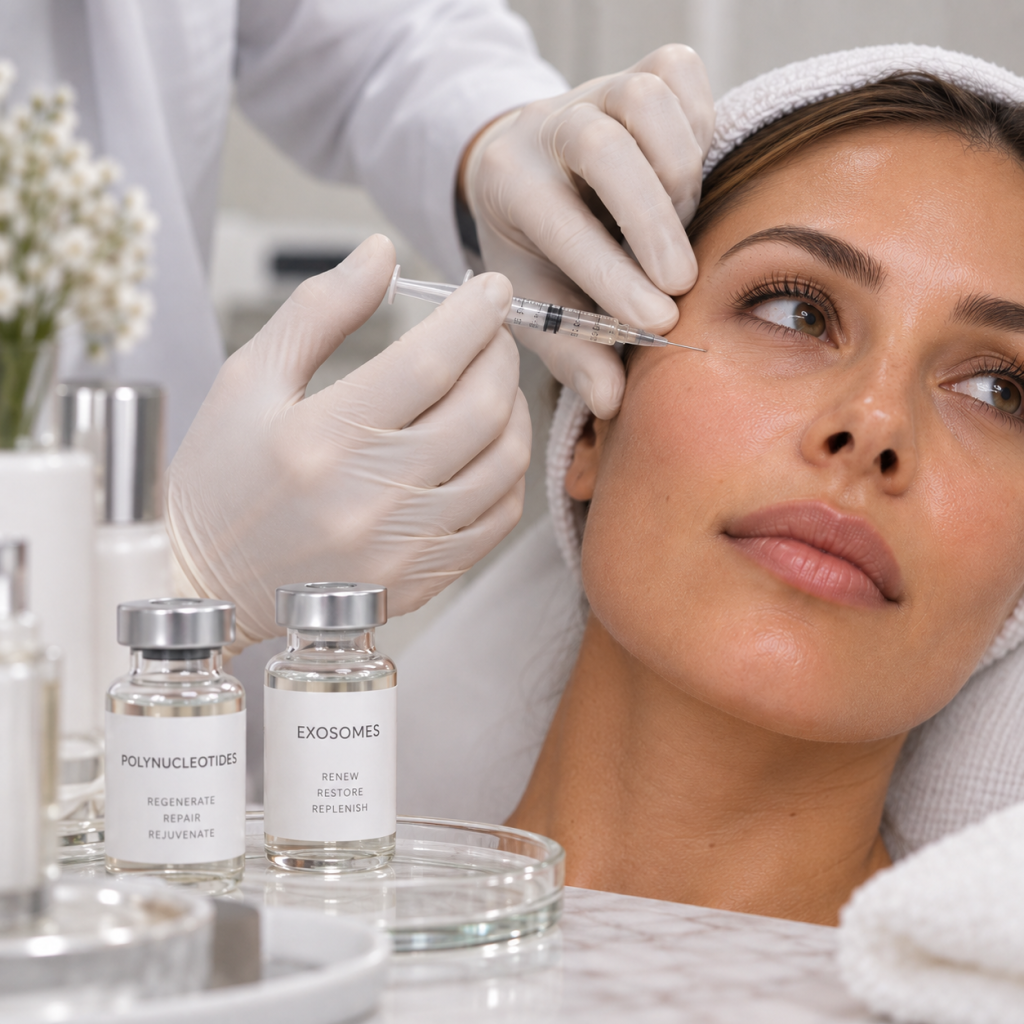
A new language is emerging in aesthetics. Instead of asking only how to fill a hollow, soften a line or replace lost volume, more patients are interested in improving the quality of the skin itself.
This has placed regenerative aesthetics firmly in the spotlight, with treatments such as polynucleotides and exosomes attracting growing attention alongside more established injectable and energy-based treatments.
For Poppy Pilgram, this shift reflects a change in what many patients want from aesthetic treatment: healthier-looking skin and subtle improvements without necessarily adding facial volume.
But polynucleotides and exosomes are very different technologies, and neither should be presented as a miracle treatment. Understanding what they actually do is essential before deciding whether they have a place in a treatment plan.
Regenerative aesthetics is a broad term used for treatments intended to support biological processes associated with tissue repair, cellular communication and skin regeneration.
This differs from treatments whose primary purpose is physical correction.
Dermal filler, for example, can replace volume or provide structural support. Regenerative treatments aim to influence the quality and behaviour of the tissue rather than simply making an area fuller.
Poppy explains:
“Patients are becoming much more interested in skin quality. They don’t necessarily want more volume; they want their skin to look healthier, smoother and more resilient while still looking completely like themselves.”
This is where treatments such as polynucleotides have become particularly relevant.
Polynucleotides are purified chains of nucleotides, which are components of DNA. In aesthetic medicine, injectable polynucleotide formulations are used with the aim of supporting tissue repair and improving skin quality.
They are thought to interact with biological processes involved in fibroblast activity, hydration, inflammation and extracellular matrix remodelling. Fibroblasts are particularly important because they produce structural components of the skin, including collagen and elastin.
Rather than physically filling a line or hollow, the objective is to encourage gradual improvements within the skin.
Poppy says:
“I explain polynucleotides as a skin-quality treatment rather than a filler. We’re not trying to create a new facial shape. The aim is to support the skin so that improvements develop progressively.”
This distinction is especially important when discussing the under-eye area.
Polynucleotides vs tear trough filler is increasingly becoming a topic of discussion during aesthetic consultations, but the two treatments should not be considered direct alternatives.
Under-eye or tear-trough filler usually involves hyaluronic acid dermal fillers placed strategically to reduce a hollow or improve the transition between the lower eyelid and cheek.
Its primary purpose is volume correction.
Polynucleotides do not provide the same structural replacement. Instead, they are used to improve the quality of the skin itself.
This means the right treatment depends on why the under-eye area looks tired.
Someone with a pronounced anatomical hollow may require structural correction. Someone whose main concerns are thin, crepey-looking skin, fine lines or declining skin quality may have a very different treatment requirement.
Under-eye filler can produce effective results in appropriately selected patients, but the tear trough is a complex treatment area.
Hyaluronic acid has an affinity for water, and some patients can develop persistent puffiness or swelling following treatment. Existing eye bags, lymphatic issues and individual anatomy can also affect suitability.
This has contributed to growing interest in treatments that do not rely primarily on adding volume.
Poppy explains:
“Not every tired-looking eye needs filler. Sometimes adding volume isn’t addressing what the patient is actually seeing. If the concern is predominantly skin quality, we need to treat skin quality.”
Polynucleotides therefore provide another option, rather than making under-eye filler obsolete.
Temporary swelling or small raised areas at injection points can occur after polynucleotide treatment. These usually settle as the product disperses and the initial injection response subsides.
This should be distinguished from the objective of treatment. Polynucleotides are not injected to permanently volumise the tear trough in the way a dermal filler may be used.
Patients should nevertheless understand that any injectable treatment around the eyes can temporarily cause swelling and bruising.
The terminology used in aesthetics can sometimes make different treatments sound interchangeable.
Polynucleotides are often discussed alongside skin boosters because both are used to improve skin quality rather than significantly alter facial contours. However, they do not contain the same ingredients or work in exactly the same way.
Traditional injectable skin boosters may focus strongly on hydration, often using hyaluronic acid-based formulations. Polynucleotides are nucleotide-based products intended to support regenerative processes within the tissue.
Understanding the formulation matters more than the marketing category attached to it.
Exosomes are tiny extracellular vesicles involved in cell-to-cell communication. They can carry biological materials such as proteins, lipids and nucleic acids, which is why they have attracted growing interest in regenerative medicine and aesthetics.
The exosome formulations used in this context are derived from plant cells rather than human cells. Their composition and biological behaviour are therefore different from human-derived exosomes, and they should not be treated as interchangeable.
In aesthetics, exosomes are being explored for their potential to support skin recovery, hydration, antioxidant activity and overall skin quality.
Exosome formulations are often used alongside treatments that create a controlled skin-repair response, such as microneedling or selected laser procedures.
The aim is to support the skin during recovery and help create a more favourable environment for repair, hydration and improved skin quality.
Because exosome technology is still an emerging area, outcomes can depend on the source, formulation, manufacturing process and concentration of the product being used.
Poppy explains:
“Exosomes are interesting because they allow us to focus on supporting skin recovery and quality without adding facial volume. As with any regenerative treatment, the formulation matters, so it’s important not to assume that every product labelled ‘exosomes’ works in exactly the same way.”
Exosome treatment is not directly comparable because they work differently.
Polynucleotides are injectable nucleotide-based treatments used to support tissue repair, fibroblast activity and skin quality.
The exosomes used here are plant-derived extracellular vesicles and are typically used alongside treatments such as microneedling or laser procedures to support the skin’s recovery environment.
One is not automatically better than the other. The choice depends on the concern being treated and the type of regenerative support required.
Research suggests that polynucleotides can support fibroblast activity and extracellular matrix remodelling, processes involved in collagen production and tissue repair.
However, the effect is gradual.
Patients should not expect the immediate structural change associated with dermal filler. Regenerative treatments rely on biological processes that occur over time, so changes in texture, elasticity and overall skin quality develop progressively.
This slower progression is part of their appeal for patients seeking subtle results.
The phrase “bio-hacking” is increasingly used to describe regenerative aesthetics, but it should not be taken too literally.
Neither polynucleotides nor exosomes reprogramme the skin or reverse biological ageing.
A more accurate description is that these approaches aim to influence or support cellular processes already involved in repair, signalling and tissue maintenance.
The distinction is important because regenerative medicine is scientifically exciting without needing exaggerated claims.
Probably not, because they solve different problems.
If someone has genuine facial volume loss, a regenerative treatment cannot necessarily recreate the structural support that can be achieved with dermal filler or fat transfer.
Similarly, adding filler to skin that simply needs better hydration, texture or regenerative support may not address the patient’s actual concern.
The future of aesthetic treatment is therefore less likely to be about replacing one category with another and more about diagnosing the problem correctly.
The regenerative boom represents an important evolution in aesthetics.
Patients increasingly have options that extend beyond simply filling lines or replacing volume. Polynucleotides are being used to support skin quality and regenerative processes, while exosome research is opening another field centred on cellular communication and tissue repair.
For Poppy Pilgram, the most important development is not simply the arrival of another fashionable injectable.
It is a change in the conversation.
Rather than asking how much product can be added to the face, regenerative aesthetics encourages practitioners and patients to consider what the skin itself needs.
And for patients seeking subtle, progressive rejuvenation, that shift towards skin quality, tissue health and natural-looking results may ultimately prove more significant than any single treatment trend.
Polynucleotides do not produce the immediate volumising effect associated with dermal filler. Improvements develop gradually as the skin responds to treatment. Patients may begin to notice changes in hydration, texture and overall skin quality over the following weeks, with results continuing to develop throughout a treatment course. The timeframe varies according to the area treated, skin condition, product used and individual biological response.
Results from under-eye polynucleotides are not permanent. Improvements in skin quality can remain visible for several months, although longevity varies between individuals and depends on factors such as age, skin condition, lifestyle and the treatment protocol used. An initial course of treatments is commonly recommended, followed by maintenance when appropriate. Polynucleotides improve the skin rather than permanently replacing lost under-eye volume.
Skin boosters are injectable treatments generally designed to improve hydration and skin quality by delivering ingredients such as hyaluronic acid directly into the skin. Exosomes work differently. The exosome formulations discussed here are plant-derived extracellular vesicles used to support the skin’s recovery environment and cellular communication, often alongside procedures such as microneedling. They therefore should not be considered simply another type of injectable skin booster.
